Burnout vs. Depression: How to Tell the Difference
Table of Contents
- Do You Know the Stress Burnout vs Clinical Depression Connection?
- What Causes Burnout Versus Depression in Your Brain and Body?
- Why Knowing the Truth About Burnout vs. Depression Can Save Your Life
- How to Tell If Its Burnout or Depression when You Feel Empty?
- Can Burnout Lead to Depression Diagnosis Over Time?
- What Are the Signs of Parental Burnout vs Postpartum Depression?
- Try This Self-Assessment Quiz Burnout or Depression Screen
- Understanding Your Burnout vs Depression Treatment Options
- Why You Need Expert Advice Distinguishing Burnout from Depression
Right now, nine out of ten people around you are secretly drowning in a silent work crisis. They wake up tired. They stare at their screens with blank eyes. They drag themselves through the day like ghosts. If you think this is just a normal part of working hard, you are making a massive mistake. As the World Health Organization warns, unmanaged stress at work damages entire lives and costs the global economy billions in lost productivity. Ignoring this mental exhaustion does not just stall your career. It actually changes your physical brain. It can turn your temporary work fatigue into a severe, lifelong mental illness. Do not let yourself become another tragic statistic. You must stop, listen, and learn the truth before you cross the point of no return. This is the real story behind burnout vs. depression, and it is time to save yourself.
We write this guide with the trusted, real-world experience of Dr. Michael J. Zizmor. He is a mental health physician licensed to practice medicine in California (Physician's and Surgeon's License G50848, NPI 1124395421) who has spent over forty years helping people understand their minds. Dr. Zizmor started his path at the University of California, Berkeley, where he earned his undergraduate degree in Psychology.
He then went to the University of Kansas School of Medicine to earn his medical doctorate. He completed his clinical internship at Boston University-affiliated hospitals and began psychiatric residency training at St. Elizabeths Hospital in Washington, DC; he is not board-certified in psychiatry. Dr. Zizmor believes that understanding how your mind works is the first step toward feeling better, and he's here to help you look at the facts clearly.
Do You Know the Stress Burnout vs Clinical Depression Connection?
We need to look at how these two conditions touch each other. They look like twins from the outside. Both make you feel heavy, slow, and totally empty. But they are not the same thing. One comes from your job. The other can come from anywhere.
When we talk about stress burnout vs clinical depression, we are looking at two different beasts. Burnout is a reaction to high stress in your environment. It is an occupational phenomenon, as the World Health Organization calls it. It is not a formal medical diagnosis.
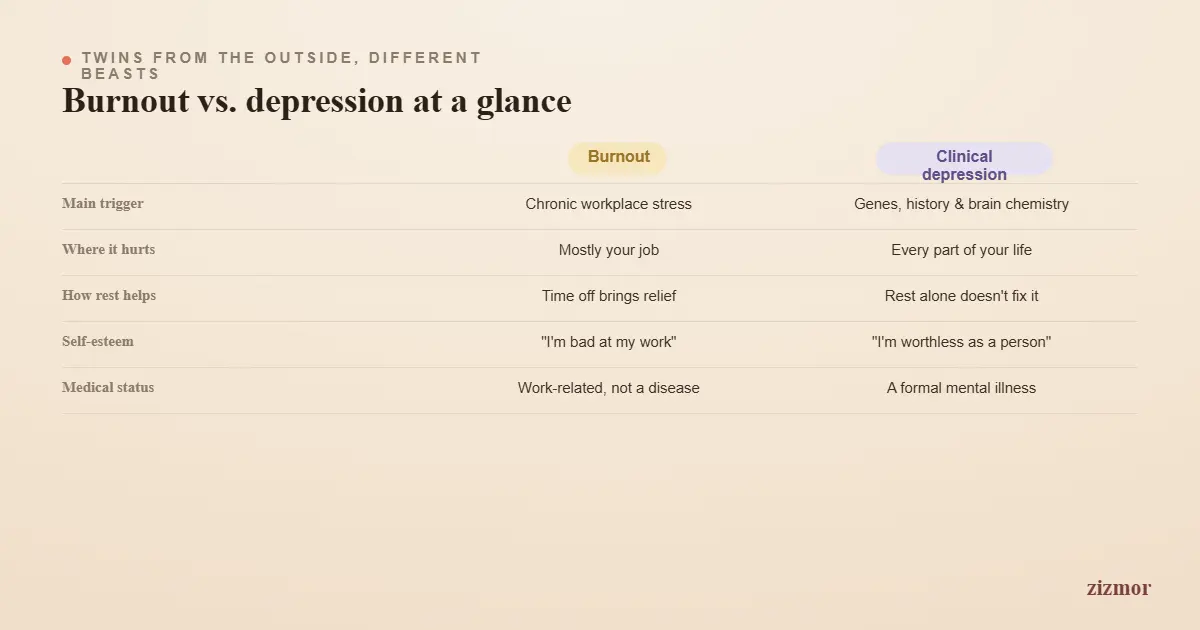
Clinical depression is a formal medical illness. The Diagnostic and Statistical Manual of Mental Disorders, or DSM-5-TR, lists it as a serious mood disorder. It changes how you think, feel, and behave in every single part of your life.
Understanding professional burnout and depression link helps us see the bridge between them. When you stay stressed for too long, your brain suffers. Your body runs on high alert. The link between them is real and dangerous. Constant work stress can push your brain into a state of deep, clinical sadness.
What Causes Burnout Versus Depression in Your Brain and Body?
What happens to make you feel this way? To fix the problem, we must understand what causes burnout versus depression.
Burnout comes from outside forces. It happens when your job demands too much of your time and energy. Maybe you have a terrible boss. Maybe your workload is way too heavy. Or maybe you work in an environment where nobody values your effort. Your energy tank simply runs dry because you have no time to refill it.
Clinical depression is much more complex. It does not just come from a bad job. It comes from a mix of your genes, your life history, and your brain chemistry. You might carry genes that make you more vulnerable to sadness. You might have gone through a deep trauma when you were young. Sometimes, depression even starts out of nowhere, with no clear stressor at all.
Let us look at a simple table to compare the two:
Why Knowing the Truth About Burnout vs. Depression Can Save Your Life
If you confuse these two, you might use the wrong fix. If you have clinical depression, taking a beach vacation will not cure you. You will just feel sad and empty on a beach. If you have work burnout, taking antidepressants will not fix your toxic boss. You need the right answer to get better.
What Is the Real Difference Between Burnout and Depression Symptoms?
We need to look at three main areas to see the truth. These are your focus, your self-esteem, and your joy. These areas show the clear difference between burnout and depression symptoms.
First, think about focus. Burnout keeps its focus on your work. You might dread opening your laptop. You might hate your daily tasks. But when you hang out with your kids or go to a movie, you can still laugh and feel normal. Depression does not have these boundaries. It follows you everywhere. It turns the whole world gray, whether you are at work or at home.
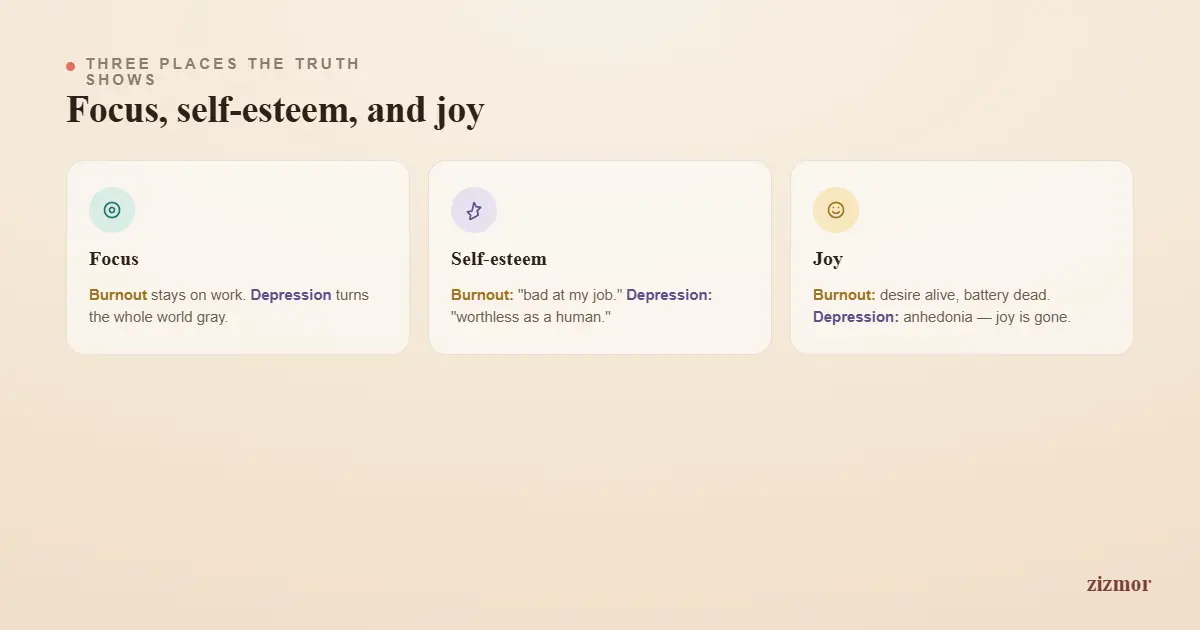
Second, look at your self-esteem. Burnout makes you feel like you are bad at your job. You feel like your work does not matter. But you do not hate yourself as a person. Depression is different. It makes you feel completely worthless. You might feel intense, irrational guilt for things you did not even do.
Third, check your joy. Doctors call the loss of joy "anhedonia". This is a major sign of clinical depression. You lose all interest in things you used to love, like hobbies, sports, or music. In burnout, you still want to do those things. You just feel too tired to start them. Your desire is alive, but your battery is dead.
How to Tell If Its Burnout or Depression when You Feel Empty?
Let us talk about how you can test yourself. Learning how to tell if its burnout or depression is about watching how you react to a break.
Imagine taking a whole week off. You turn off your phone. You sleep in. You walk in the woods.
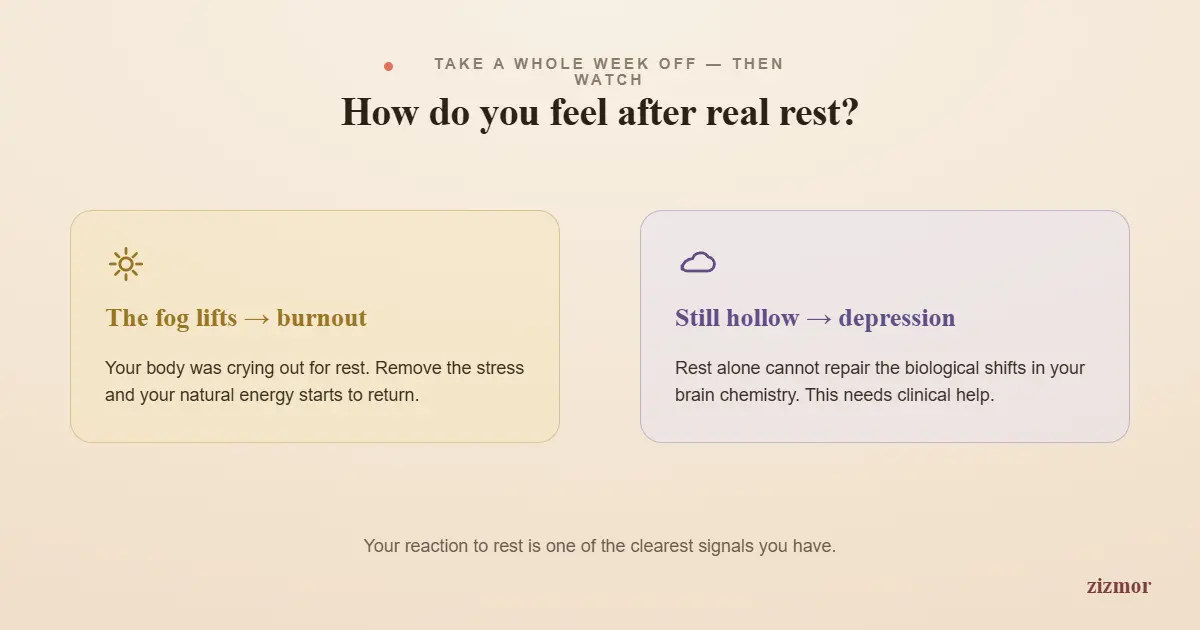
If your heavy feelings start to lift, you are likely dealing with burnout. Your body was just crying out for rest. Once you remove the stress, your natural energy starts to return.
If you spend that week off feeling just as hollow, heavy, and hopeless, it is likely depression. Rest alone cannot repair the biological shifts in your brain chemistry. You need clinical help to heal.
Is My Fatigue Burnout or Depression?
We hear this question all the time from people who feel physically broken. They ask: is my fatigue burnout or depression?
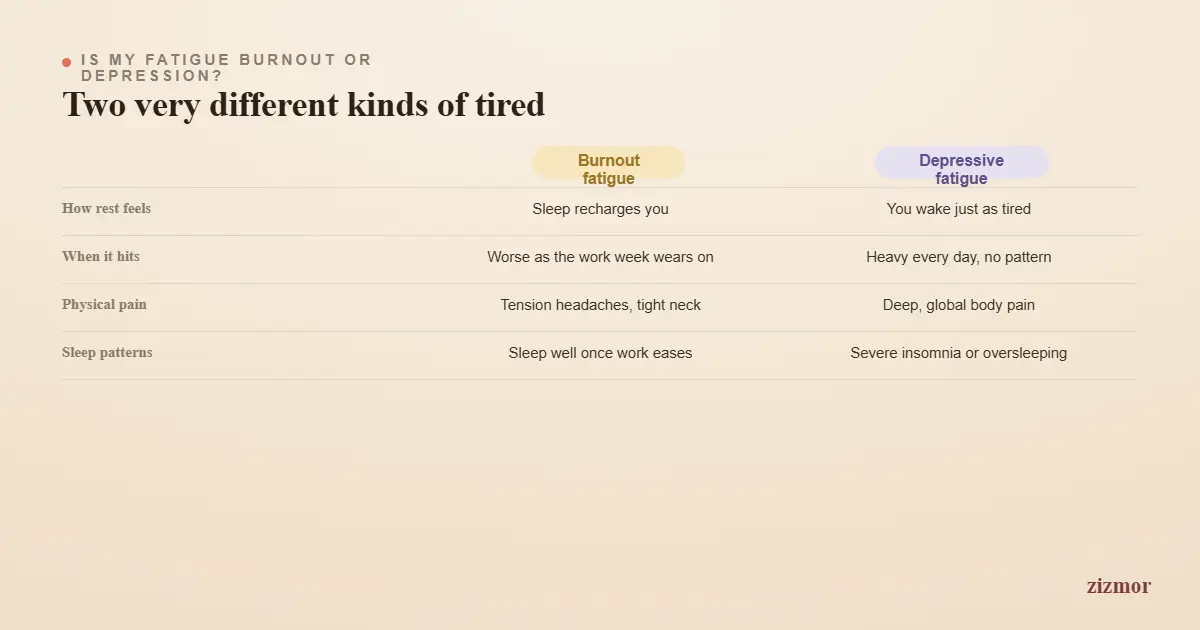
Fatigue from burnout is a direct response to overwork. Your body has used up all its stress hormones. You feel physically heavy, and your muscles might ache. But this type of fatigue disappears when you get real, uninterrupted sleep and put work aside.
Fatigue from depression is a deep, chemical weight. It does not care how many hours you sleep. You can sleep for twelve hours and still feel like you are walking through wet cement. It is often tied to bad sleep patterns. You might wake up at 3:00 AM and find it impossible to fall back asleep. Or you might sleep all day long and still feel totally drained.
Let us look at a table comparing these physical patterns:
Can Burnout Lead to Depression Diagnosis Over Time?
Many people think they can just push through burnout. They wear their long hours like a badge of honor. This is incredibly dangerous.
Yes, you must know that the answer is a clear yes. Unmanaged burnout is a primary stepping stone to mental illness. So, can burnout lead to depression diagnosis? Absolutely. If you leave burnout untreated, you run a very high risk of developing a clinical depressive episode.
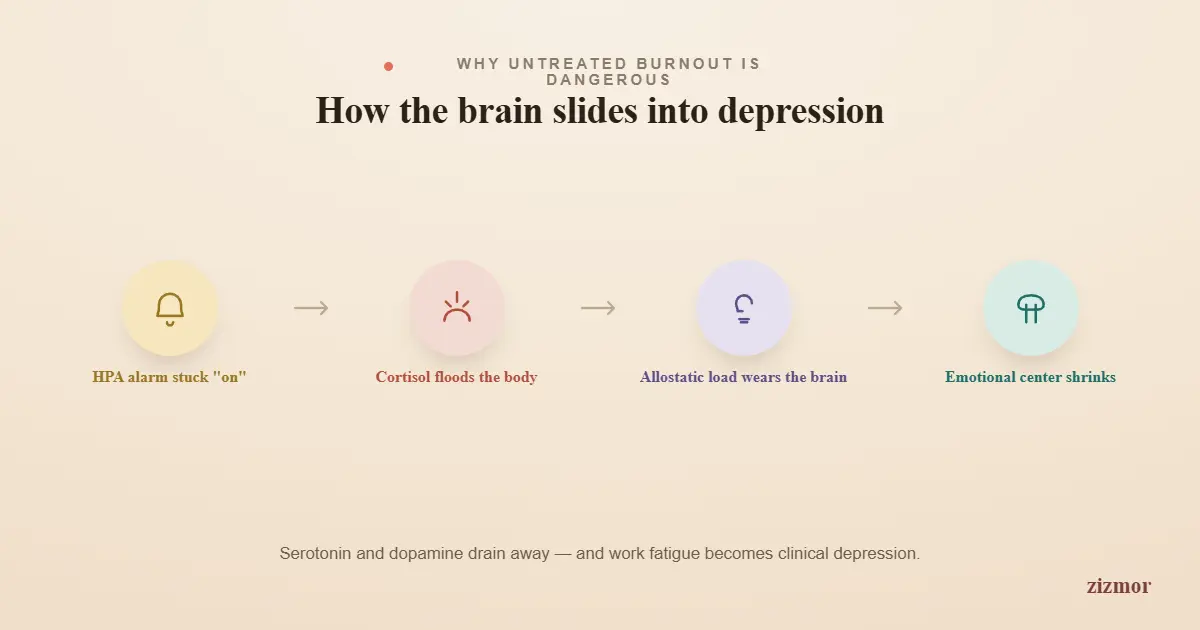
What happens in your body when you ignore burnout? Let us explain it simply.
When you face constant stress, your brain turns on its emergency alarm system. This system is called the HPA axis. It floods your body with a stress hormone called cortisol.
If you never rest, this alarm system gets stuck in the "on" position. Over time, your brain gets tired of being flooded with cortisol. It starts to break down. This chronic wear and tear is called allostatic load.
This heavy load physically changes your brain. It stops your brain from making new cells. It drains your supply of feel-good chemicals like serotonin and dopamine. Your brain's emotional center starts to shrink. This biological collapse is exactly how a simple state of work fatigue turns into clinical depression.
How to Prevent the Brain Slide
You do not have to let this happen to you. You can take steps right now for managing workplace burnout to prevent depression.
First, you must look at your work culture. Do you feel safe talking to your boss? The American Psychological Association says that a safe workplace is your best shield. Employees who feel safe are much less likely to feel emotionally drained (17% vs 34%).
If you do not feel safe, you must protect yourself. Set hard boundaries. Turn off your work emails at 6:00 PM. Do not take on extra tasks when your plate is already full. Learn to say "no" to the toxic culture of endless hustle.
To make things clear, here is a simple guide on what to watch for:
- The Hustle Trap: Do not tie your entire self-worth to your job production.
- The Silence Trap: Do not hide your stress. Talk to a trusted coworker, friend, or doctor.
- The Rest Trap: Do not spend your weekends catching up on work. Use that time to truly disconnect.
What Are the Signs of Parental Burnout vs Postpartum Depression?
We must also look at what happens at home. Burnout does not just happen at an office desk. It can happen to parents who work around the clock to care for their children.
It is vital to recognize the signs of parental burnout vs postpartum depression because they look so similar but need very different types of help.
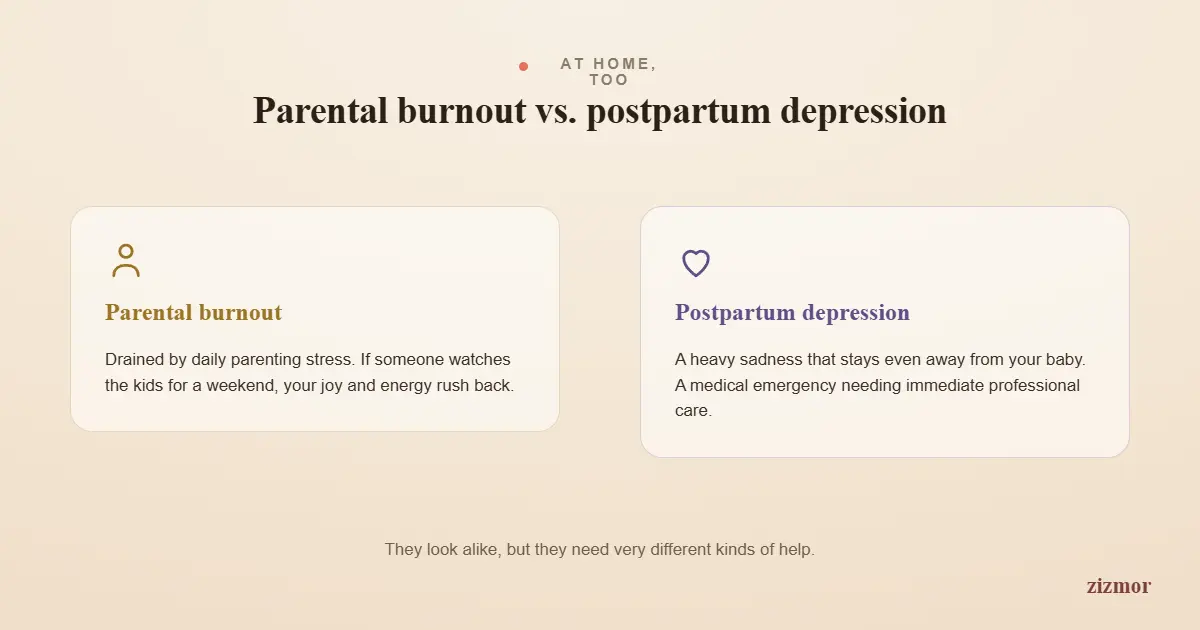
Parental burnout happens when the daily stress of parenting becomes too much to handle. You feel completely drained by your kids. You might start to distance yourself from them just to protect your sanity. You feel like a bad parent. But if someone else watches your kids for a weekend, you feel your joy and energy rush back.
Postpartum depression is a formal clinical illness that hits new mothers after they give birth. It is driven by massive shifts in hormones, mixed with sleep loss and genetics.
A mother with postpartum depression feels a heavy, constant sadness that does not go away when she is away from her baby. She might cry for hours for no clear reason. She might feel intense guilt or worry that she does not love her baby. In severe cases, she might even think about hurting herself or her child. This is a medical emergency that needs immediate, professional doctor care.
Try This Self-Assessment Quiz Burnout or Depression Screen
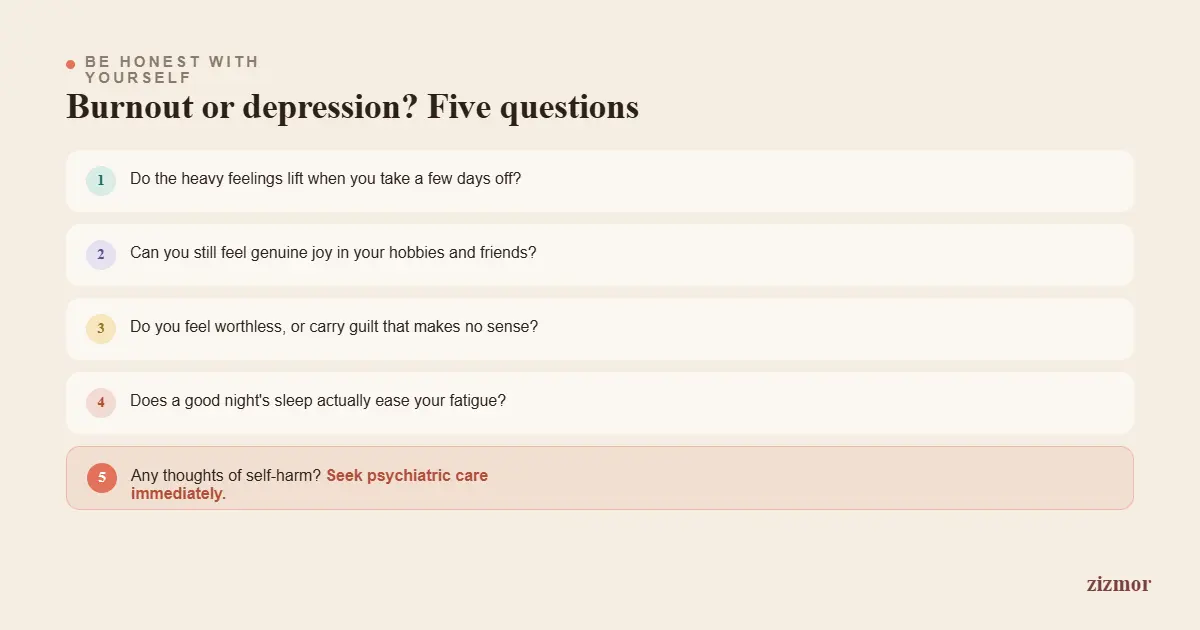
If you are still not sure where you stand, we have put together a simple test for you. This self-assessment quiz burnout or depression screener will help you look at your feelings.
Ask yourself these five questions. Be honest with your answers.
- Question 1: Do your heavy, sad feelings disappear when you take a few days off from your work or caregiving duties?
- Yes: This points toward work burnout.
- No: This points toward clinical depression.
- Question 2: Can you still feel genuine joy when you spend time on your hobbies, your friends, or your favorite meals?
- Yes: Your capacity for joy is alive. This is likely burnout.
- No: You are experiencing anhedonia. This is a primary sign of depression.
- Question 3: Do you feel like a worthless human being, or do you carry deep guilt that does not make sense?
- Yes: Depression often attacks your core self-worth.
- No: Your bad feelings are limited to your work performance.
- Question 4: How does your fatigue react to a good night of sleep?
- It gets better: Your body was just tired. This points to burnout.
- It stays heavy: Your fatigue is constant. This points to depression.
- Question 5: Have you had any thoughts of hurting yourself, dying, or suicide?
- Yes: This is a clear sign of severe depression. You must seek professional psychiatric care immediately.
- No: Pure burnout rarely causes thoughts of self-harm.
Understanding Your Burnout vs Depression Treatment Options
Once you know what you are dealing with, you must choose the right way to heal. The burnout vs depression treatment options are very different.
If you have burnout, the main goal is to change your environment. You must reduce your workload. You must create physical and mental space between yourself and your job.
If you have clinical depression, you cannot just vacation your way out of it. You need professional clinical treatment.
What Does Therapy for Burnout vs Depression Look Like?
When you seek help, you will find that therapy for burnout vs depression targets different parts of your mind.
Therapy for burnout helps you build strong life boundaries. A therapist will help you look at why you work so hard. They will help you challenge the belief that you must be perfect to be worthy. You will learn how to speak up for yourself at work, delegate tasks, and say no without feeling guilty.
Therapy for depression goes much deeper. It uses proven methods like Cognitive Behavioral Therapy (CBT) to change how your brain processes thoughts. It helps you challenge deep, negative beliefs about yourself and the world. For many people, therapy is paired with medication. Antidepressants can help balance your brain chemistry so you can have the energy to do the work of healing.
What Are the Best Coping Strategies for Burnout Not Depression?
If you have verified that your struggles are pure burnout, you can start healing today. You must focus on calming your nervous system and changing your daily habits.
These coping strategies for burnout not depression can help you recharge your empty battery:
- Unplug Completely: Set a strict time to turn off your phone and computer. Do not look at work messages on your weekends.
- Calm Your Nervous System: Use simple breathing exercises or short walks to lower your cortisol levels.
- Refill Your Tank: Do things that bring you simple joy, like drawing, gardening, or listening to music, even if you only have ten minutes.
- Job Crafting: Talk to your boss about changing your duties, or start looking for a new role that respects your mental health.
How Long Does Recovery from Burnout vs Depression Take?
We must be realistic about the timeline for healing. The path to recovery from burnout vs depression looks very different for each person.
Recovery from burnout can happen relatively quickly. Once you take a real break and establish boundaries, you can feel your energy return in a few weeks or months.
Recovery from clinical depression is a longer, non-linear journey. It takes time for therapy to change your thought patterns. It takes time for medication to stabilize your brain chemicals. You will have good days and bad days, and that is completely normal.
Why You Need Expert Advice Distinguishing Burnout from Depression
We want to close with some vital words of wisdom. Getting expert advice distinguishing burnout from depression is the most important step you can take today.
Dr. Michael J. Zizmor has spent over forty years helping patients find their way through these exact mental struggles. He knows that trying to solve these issues on your own can lead to years of pain and wasted effort. Do not let fear or shame keep you from getting help.
When you understand the true nature of burnout vs. depression, you can take back control of your life. If you feel like your battery is empty, but your heart still wants to live and laugh, take a step back and rest. But if you feel like the entire world has turned cold and dark, please reach out to a professional mental health provider right away. We are here to support you every single step of the way. You deserve to feel whole again.
FAQs
Can you take FMLA leave for burnout?
Yes. You can use FMLA leave if your severe exhaustion leads to a serious health condition. We recommend getting a doctor to sign your papers. Do not wait until you completely crash. Act now to save your mental health.
Can a brain scan show severe burnout?
Yes. A scan can show a smaller emotional center and a swollen fear center in your head. Chronic stress physically rewires your nervous system. Do not let stress melt your brain. Reach out to our team today.
Can you claim disability for chronic burnout?
No. You cannot get disability benefits for pure burnout because it is not a medical illness. However, if your exhaustion triggers severe clinical depression, you can apply. Please stop pushing yourself. Let us help you heal today.
Can burnout make your hair fall out?
Yes. Chronic stress forces your hair roots into a resting state. This causes massive shedding months later. Your body is screaming for a real break. Do not ignore these warning signs. Call our medical clinic right now.
Does burnout cause high blood pressure?
Yes. Constant work tension keeps your heart racing and damages your blood vessels over time. This silent physical killer heavily increases your risk of sudden heart attacks. Do not sacrifice your life for a job. Contact us today.