7 Critical Differences Between ADHD and ADD Symptoms Explained
Table of Contents
- Is ADD Still a Valid Diagnosis vs ADHD and What Is the Official Name for ADD Now?
- What Are the Key Differences ADHD vs ADD Diagnosis Criteria Under the DSM-5-TR?
- What Is the Clinical Reality of the Difference Between ADHD and ADD Symptoms in Adults?
- Why Are ADHD vs ADD Symptoms in Girls So Easily Missed?
- How to Tell If Your Child Has ADD or ADHD?
- What Is the Academic Challenge of the Impact of ADD vs ADHD Symptoms on Learning?
- What Are the Options When Comparing ADD and ADHD Treatment Approaches?
- The ADD vs ADHD Symptoms Checklist for Mild ADHD Symptoms vs Severe ADD
- What Is the Final Takeaway on the Difference Between ADHD and ADD Symptoms?
Right now, millions of people are silently drowning. They lose their jobs. They destroy their marriages. They watch their self-esteem crumble into dust. Over fifteen million adults in the United States fight this hidden monster every single day. Worse, a massive wave of adults has no idea why they are struggling. The CDC shows that around seven million American children—nearly 11.7%—already have an attention deficit diagnosis. If you do nothing, you risk letting your child fall behind permanently. You risk letting your own career slip through your fingers. Do not wait for another failed review or another tearful parent-teacher meeting. Pick up the phone. Talk to us today. Let us help you find the answers.
Many people get confused by the terms. You hear them on the playground and in office meetings. What is the real difference between ADHD and ADD symptoms? This confusion causes massive delays in getting help. People suffer for years because they do not understand what is happening inside their own brains.
We have been treating families for decades. Dr. Michael J. Zizmor brings over forty years of hands-on mental health care experience. He started his path at the University of California, Berkeley. There, he earned his degree in psychology to understand the human mind. He then went to the University of Kansas School of Medicine for his medical doctorate. He built his clinical skills during an internship at Boston University-affiliated hospitals. After that, he finished his psychiatric residency training at St. Elizabeths Hospital in Washington, DC. Dr. Zizmor has seen how failing to address these focus issues ruins lives. He knows that catching these signs early changes everything.
Is ADD still a valid diagnosis vs ADHD and what is the official name for ADD now?
Let us address the most common question first. Is ADD still a valid diagnosis vs ADHD? The short answer is no. Doctors do not use the term ADD as an official medical diagnosis anymore.
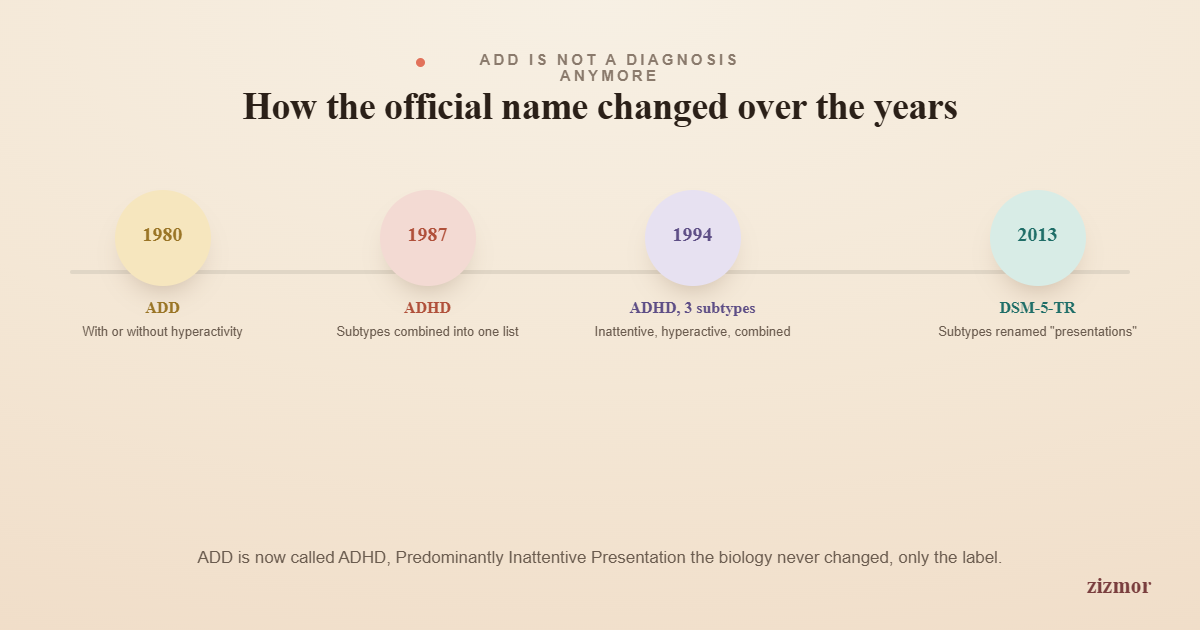
Years ago, the American Psychiatric Association decided to clean up the medical language. They wanted a unified name. They wanted to show that focus struggles and hyperactive behaviors come from the same biological root.
So, what is the official name for ADD now? The formal medical term is Attention-Deficit/Hyperactivity Disorder, Predominantly Inattentive Presentation.
This can sound confusing. Why put "hyperactivity" in the name if a person is not hyperactive? The medical world uses ADHD as an umbrella term. It is like a big tent. Under this tent, there are three ways the condition can show up.
Let us look at how the name changed over the years.
This history matters. It shows that we now view attention as a spectrum. Your symptoms are not set in stone. They can shift. A wild, hyperactive child can turn into a quiet, distracted adult.
What are the key differences ADHD vs ADD diagnosis criteria under the DSM-5-TR?
Specialists use a strict checklist to determine whether you or your child has this condition. The DSM-5-TR is the manual we follow. The rules are clear. We evaluate the key differences between ADHD vs ADD diagnosis criteria by looking at two main symptom lists.
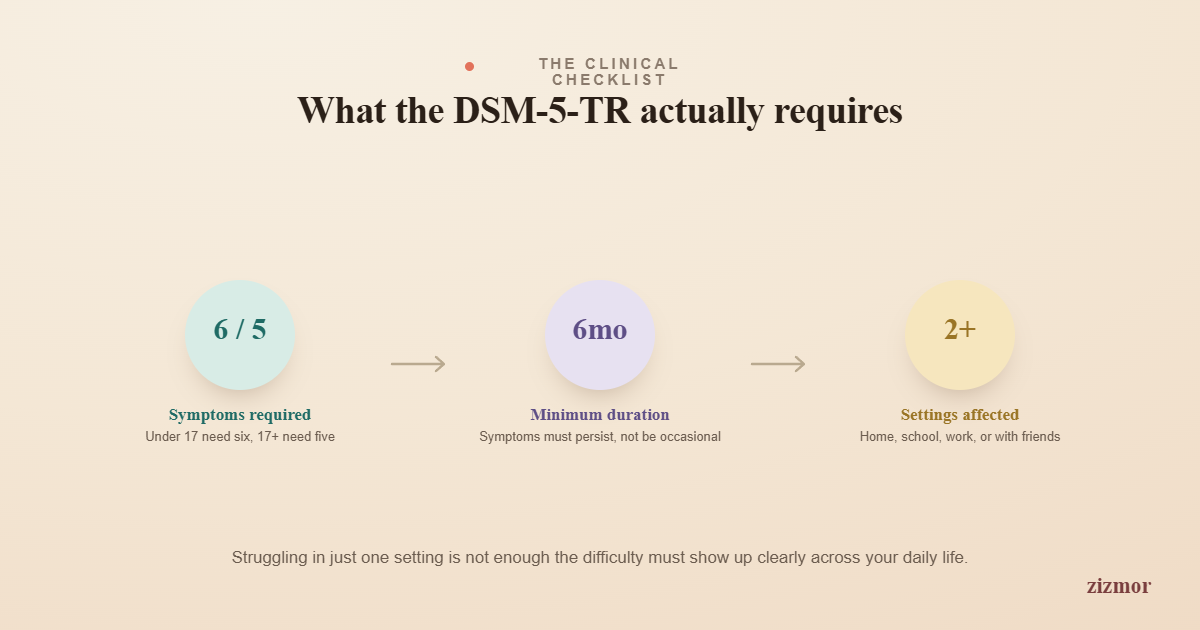
Children up to age 16 must show at least six symptoms. Adults and older teens aged 17 and up must show at least five symptoms. These traits must stick around for at least six months. They must show up in two or more settings. This means you cannot just struggle at school. You must also struggle at home, at work, or with friends. The symptoms must clearly make your daily life harder.
Symptoms of inattentive ADHD vs hyperactive-impulsive type
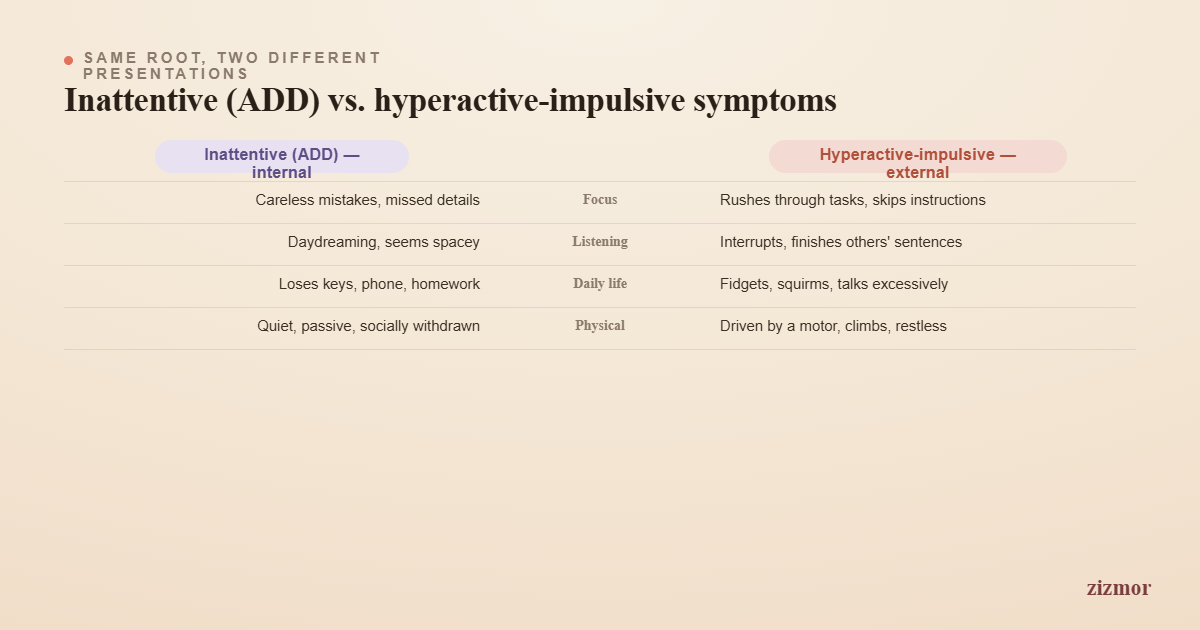
The difference lies in where the struggle happens. When we look at the symptoms of inattentive ADHD vs hyperactive-impulsive type, one is internal, and the other is external.
Inattentive type (formerly called ADD) happens inside your mind. You do not disrupt the room. You struggle with cognitive fatigue, working memory, and focus.
Hyperactive-impulsive type happens outside. You struggle with physical movement, blurting out words, and waiting your turn.
Let us look at how these symptoms compare side by side.
Can you have ADHD without hyperactivity symptoms?
Yes, you absolutely can. Many people ask us: can you have ADHD without hyperactivity symptoms? It is one of the biggest reasons adults do not get diagnosed. They think, "I was never hyperactive as a kid, so I cannot have ADHD."
But the science tells a different story. If you have enough inattentive symptoms, you get the official diagnosis of ADHD, predominantly inattentive presentation. You do not need to show a single sign of physical restlessness. Your brain struggles to regulate dopamine and norepinephrine in the prefrontal cortex, much like a hyperactive brain. The biological engine is the same. The way it shows up is different.
What is the clinical reality of the difference between ADHD and ADD symptoms in adults?
Focus struggles look different when you grow up. A child bounces off walls. An adult bounces from job to job. Understanding the difference between ADHD and ADD symptoms in adults is key to saving careers and relationships.
For adults with hyperactive ADHD, physical hyperactivity goes inward. You do not climb trees anymore. Instead, you feel a constant, itchy inner restlessness. You cannot sit through a movie. You cannot relax on vacation. Your mind feels like a television that is constantly switching channels.
For adults with inattentive ADHD (or ADD), the battle is with organization and energy. You deal with heavy brain fog. You struggle with "time blindness". You underestimate how long a task will take. You miss deadlines, pay bills late, and feel chronically overwhelmed.
Understanding combined type ADHD vs inattentive
Some adults face both sides of the coin. When understanding combined-type ADHD vs. inattentive ADHD, you are looking at different levels of complexity.
In the inattentive type, your energy is low. You are the quiet daydreamer. You struggle to start tasks because your brain feels under-aroused.
In the combined type, you meet the criteria for both inattention and hyperactivity. You have wild focus swings. One minute you are hyper-focused on a random project. The next minute, you are physically restless, impulsive, and completely exhausted. Your brain is constantly fighting both the urge to move and the inability to focus. It is incredibly tiring.
Why are ADHD vs ADD symptoms in girls so easily missed?
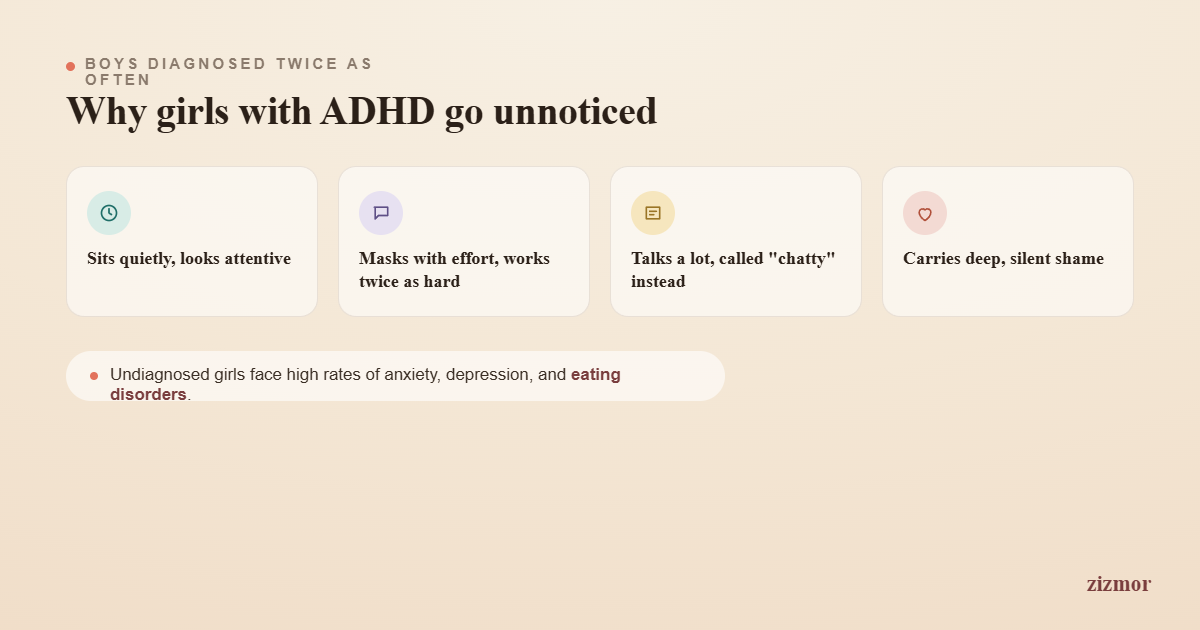
Girls suffer in silence. The data shows a massive gap. Boys are diagnosed twice as often as girls in childhood. This is not because girls lack focus. It is because of how the symptoms show up.
Let us explore the ADHD vs ADD symptoms in girls.
Boys tend to display hyperactive, outward behaviors. They run, shout, and disrupt the classroom. Teachers notice them immediately.
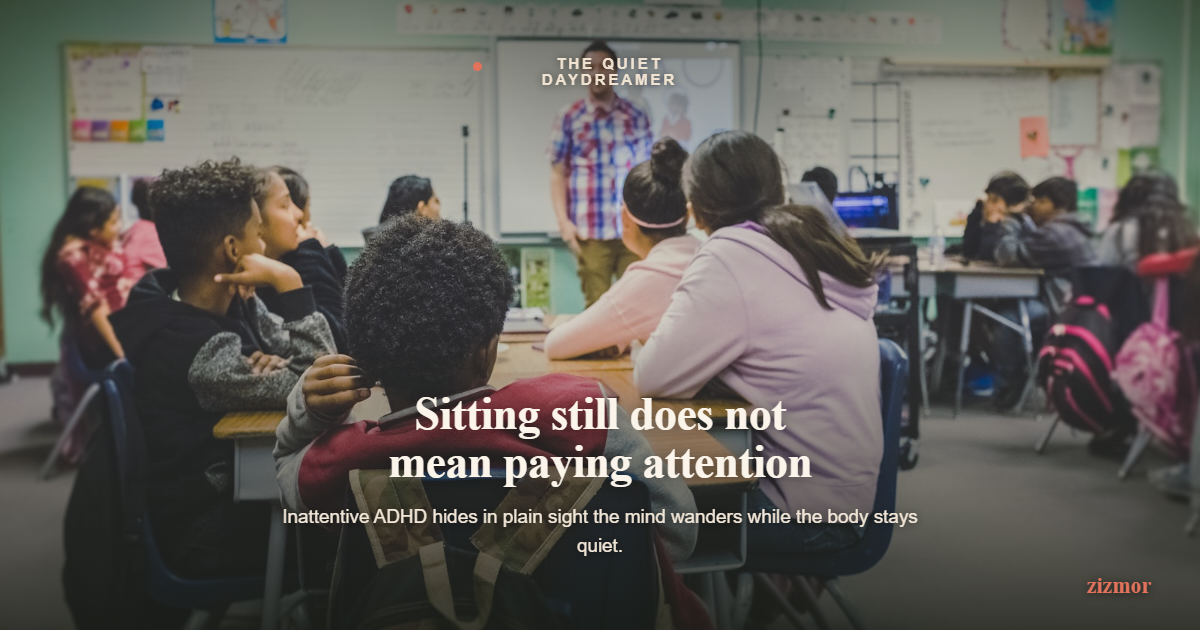
Girls are more likely to have the inattentive type, or ADD. They do not disrupt the class. They sit quietly at their desks. They look like they are paying attention, but their minds are miles away. They use masking to hide their struggles. They work twice as hard to get average grades.
When girls do show hyperactive symptoms, they are often verbal rather than physical. They talk excessively. They interrupt others or act in an overly emotional way. This gets labeled as being "chatty" or "dramatic" rather than a real medical issue.
This delay in diagnosis hurts. Girls with untreated attention issues grow up with deep feelings of shame. They feel lazy or stupid. They face high rates of anxiety, depression, and eating disorders.
How to tell if your child has ADD or ADHD?
As a parent, you watch your child every day. You see them struggle, but you might not know why. Let us look at how to tell if your child has ADD or ADHD. We need to watch how they interact with their world.
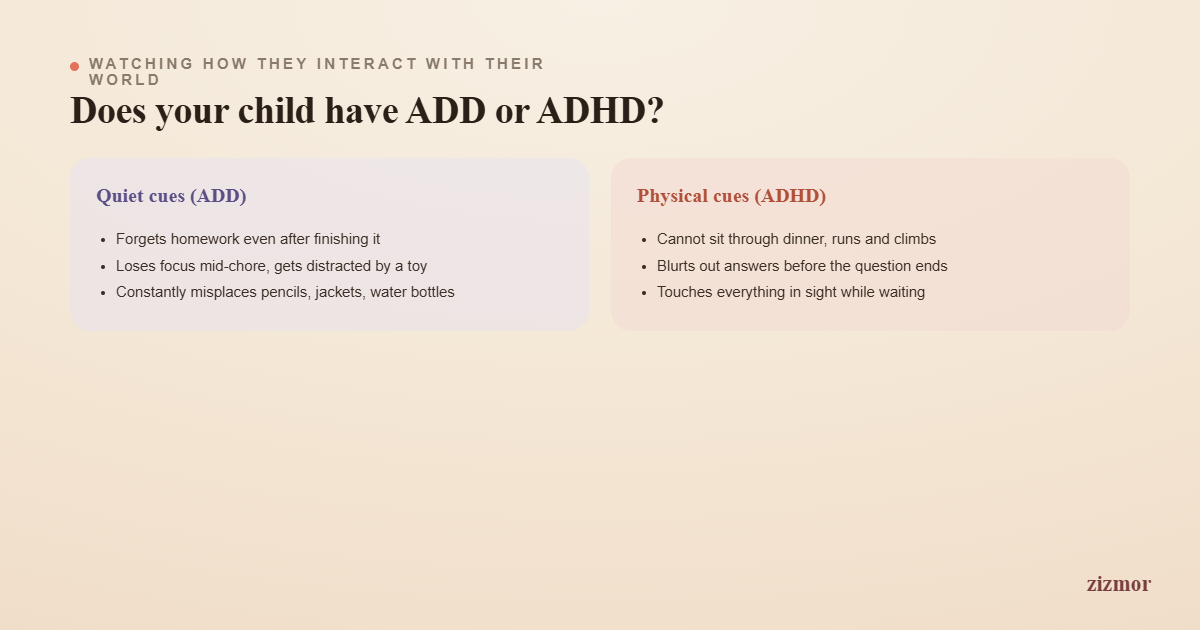
If your child has classic hyperactive ADHD, you will see physical cues. They cannot sit through dinner. They run and climb in dangerous places. They blurt out answers before you finish the question. They touch everything in sight while waiting in line.
If your child has ADD (inattentive ADHD), the cues are quiet. They forget their homework even after completing it. They struggle to follow a simple three-step chore. You ask them to put on their shoes, and ten minutes later, they are playing with a toy, completely forgetting the task. They constantly lose their pencils, water bottles, and jackets. They seem spacey when you speak to them directly.
What is the academic challenge of the impact of ADD vs ADHD symptoms on learning?
School demands heavy executive function. This is exactly where attention deficits strike. We must understand the impact of ADD vs ADHD symptoms on learning.
The brain pathways that manage focus, planning, and reward rely on dopamine and norepinephrine. When these chemicals are low, school becomes a daily mountain to climb.
Inattentive symptoms (ADD) silently hurt learning. A student misses critical steps in written instructions. They struggle with working memory. They cannot hold multiple math steps in their head at once. They read a paragraph over and over but cannot digest the meaning.
Hyperactive symptoms hurt learning through disruption. Sitting still for six hours is physically painful for these kids. They squirm, drop their pencils, and distract their peers. They rush through tests, making careless errors on questions they actually know.
Attention deficits are not learning disabilities. A child with ADHD can be highly intelligent. But they struggle to execute. Up to 25% of kids with ADHD also have a co-occurring learning disability like dyslexia. This makes the academic battle even harder.
What are the options when comparing ADD and ADHD treatment approaches?
There is no single answer for everyone. When comparing ADD and ADHD treatment approaches, we look at a combination of medical and behavioral plans.
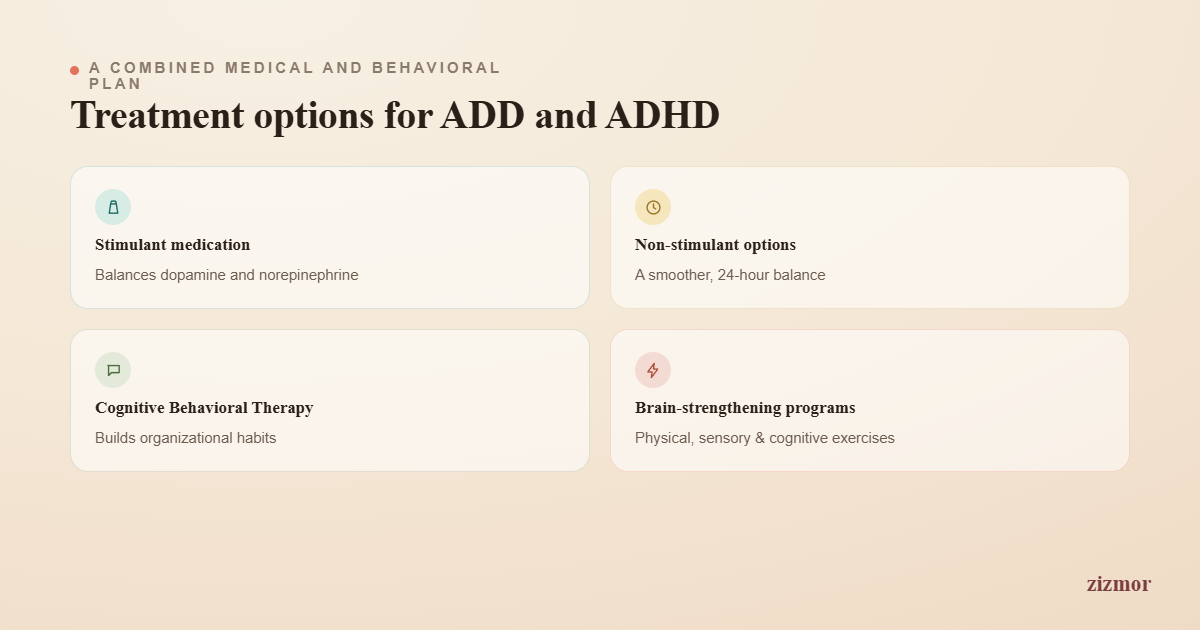
Medication is often the first step to balance brain chemistry. Stimulants like methylphenidate or amphetamines work by keeping dopamine and norepinephrine active in the prefrontal cortex. This calms the hyperactive brain and wakes up the inattentive brain.
Non-stimulants are also useful. They offer a smoother, 24-hour balance without the physical spikes of stimulants.
Behavioral therapies are just as important. For adults, Cognitive Behavioral Therapy (CBT) helps build organizational habits and tackle negative thoughts.
We also look at brain-strengthening programs like Brain Balance. This program uses physical, sensory, and cognitive exercises to build stronger neural pathways. Harvard and McLean Hospital studied this program. The results showed a major drop in ADHD symptoms, matching the effects of low-dose stimulants.
Explaining ADHD vs ADD to a loved one
Focus struggles are often misunderstood as laziness. When explaining ADHD vs ADD to a loved one, you must change how they see the condition. Do not frame it as a bad habit. Frame it as a chemical regulation problem.
Use simple analogies.
Tell them the brain's transmission system is missing fluid. The signals cannot easily leap across the gaps.
For ADD, use the filter analogy. A typical brain has a filter that blocks out background noise and random thoughts. An ADD brain attends to everything at once. It is like trying to read a book while ten people are shouting at you.
For hyperactive ADHD, use the car analogy. The brain has a Ferrari engine but bicycle brakes. It wants to stop and wait, but the braking system is not yet strong enough.
This framing takes away the blame. It turns friction into support.
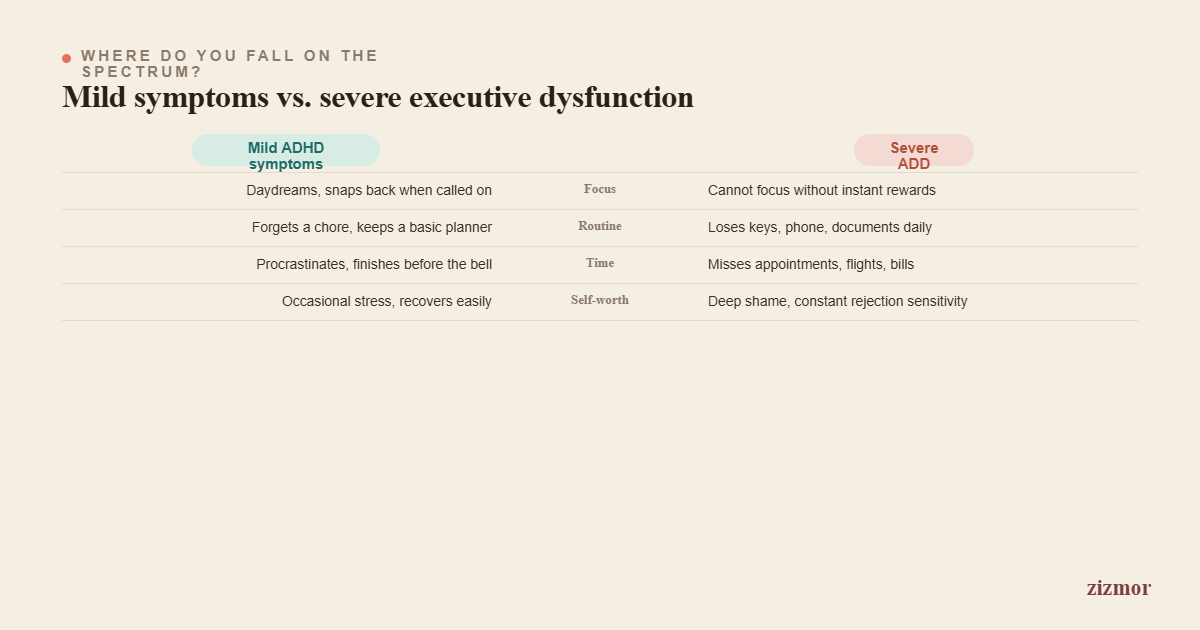
The ADD vs ADHD symptoms checklist for mild ADHD symptoms vs severe ADD
We use structured checklists to see where you or your child falls on the spectrum. Here is our ADD vs ADHD symptoms checklist for mild ADHD symptoms vs severe ADD:
What is the final takeaway on the difference between ADHD and ADD symptoms?
Understanding the difference between ADHD and ADD symptoms is the first step toward reclaiming your life or saving your child's future. These focus struggles are real, biological conditions. They are not character flaws. They are not the result of bad parenting or laziness.
We are here to help you navigate this journey. With decades of medical expertise, Dr. Michael J. Zizmor and our team can help you find the right path. Do not let another day slip away in confusion and frustration. Reach out to us. Schedule your consultation today, and let us build a clear, supportive roadmap together.
FAQs
Does eating sugar cause childhood ADHD?
No. Sugar does not damage your child’s developing brain. It only causes short bursts of hyper energy. Stop blaming yourself for their diet. Call us right now to get a real clinical diagnosis and start helping them today.
Is ADHD passed down through genetics?
Yes. Your genes play a massive role in this daily battle. You are not a bad parent, and your child is not lazy. Call us today. We will help you understand your family's unique brain chemistry and find peace.
Do screens cause your child's ADHD?
No. Screens do not create this focus disorder. However, loud digital media will overstimulate your child's brain, worsening symptoms. Stop letting screens babysit. Call us right now to rebuild your child's focus and reclaim their future.
Can bad parenting trigger attention deficits?
No. Bad parenting does not trigger this condition. It is a real biological difference in their brain. Do not let guilt paralyze you. Contact us today. We will give you the exact tools to help your child thrive.
Does untreated adult ADHD ruin sleep?
Yes. A racing mind and physical restlessness can completely destroy your sleep. Chronic fatigue then makes your daytime focus struggles much worse. Stop suffering through exhausting nights. Contact us right now to reclaim your energy and sleep peacefully.
This article is for general information only. It is not a substitute for individual medical advice. For guidance specific to your situation, please contact our team or start an intake to speak with a clinician.