Navigating College: Comprehensive Mental Health Treatment for Berkeley Students
Table of Contents
- 1. Is Anxiety Just a Normal Part of the Berkeley Experience?
- 2. Who Bears the Heaviest Burden in the Race for Grades?
- 3. Are You Losing Your Motivation, or Is It Clinical Depression?
- 4. What Really Happens Inside the Tang Center Ecosystem?
- 5. How to Get Started with Campus Counseling
- 6. Why Is Getting a Fast Appointment So Hard?
- 7. Which Therapy Style Actually Works for Your Mind?
- 8. Can You Actually Afford Quality Therapy in the East Bay?
- 9. How to Find a Long-Term Therapist Off-Campus
- 10. Can Online Therapy and Apps Save You Time?
- 11. Why Identity Matters When You Sit on the Couch
- 12. Choosing the Right Mental Health Treatment Berkeley Students Need
- 13. Reclaiming Your Path and Moving Forward
Walk down Sproul Plaza. Look around at the crowd. If you count five people near you, stats say three of them are quietly drowning from a major mental health issue right now. Even worse, one of them has seriously thought about suicide in the last year. If you do not take action right now, the high-pressure cooker of college will drain your potential. Do not wait until you are completely broken to seek help. We built this guide to give you a clear map to the best mental health treatment Berkeley students can access today.
We write this guide with the trusted, real-world experience of Dr. Michael J. Zizmor. He is a mental health physician licensed to practice medicine in California (Physician's and Surgeon's License G50848, NPI 1124395421) who has spent over forty years helping people understand their minds. Dr. Zizmor started his path at the University of California, Berkeley, where he earned his undergraduate degree in Psychology.
He then went to the University of Kansas School of Medicine to earn his medical doctorate. He completed his clinical internship at Boston University-affiliated hospitals and began psychiatric residency training at St. Elizabeths Hospital in Washington, DC; he is not board-certified in psychiatry. Dr. Zizmor believes that understanding how your mind works is the first step toward feeling better, and he's here to help you look at the facts clearly.
We want you to feel seen and heard. This guide will show you how to navigate the complex world of student mental health without the confusing medical jargon. Let us dive in.
Is Anxiety Just a Normal Part of the Berkeley Experience?
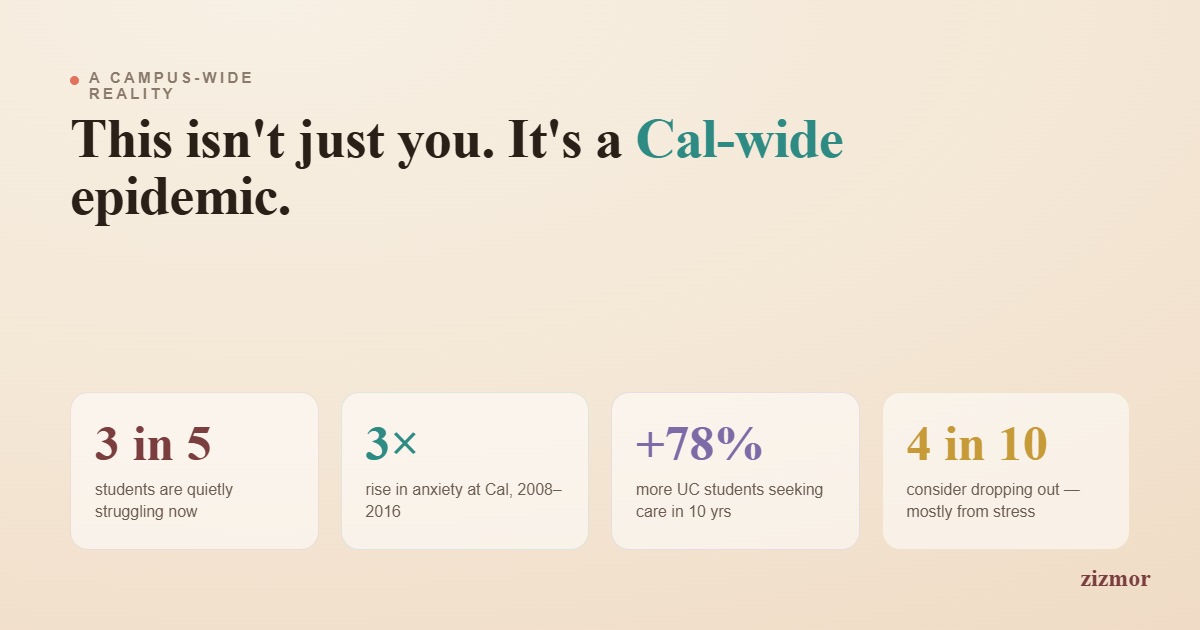
Many students think that feeling constant panic is just what it takes to survive at Cal. But there is a huge difference between normal exam stress and a real clinical condition. A study by researchers at the UC Berkeley Goldman School of Public Policy showed that anxiety rates among Berkeley students tripled between 2008 and 2016. This is not just a personal struggle. It is a massive campus-wide epidemic.
The data shows that real-world problems drive this spike in worry. The researchers found that students who struggle to pay bills are nearly three times more likely to have anxiety. If you spend over 20 hours a week on social media or digital devices, your risk of anxiety goes up by 53 percent. Even your family background plays a role. Students whose mothers have college degrees have a 45 percent higher chance of experiencing anxiety.
When you ignore these feelings, they can lead to bigger problems. Untreated anxiety makes you three times more likely to struggle with alcohol or drug abuse. It also hurts your future, cutting average earnings by 11 percent after you graduate. That is why finding high-quality anxiety treatment for Berkeley University students is so vital to your success.
Who Bears the Heaviest Burden in the Race for Grades?
The pressure to succeed is intense, but it does not affect everyone the same way. Stats show that some students carry a much heavier psychological weight. Female students, low-income students, BIPOC students, and LGBTQIA+ students face much higher rates of distress and depression. For example, transgender and non-binary students have some of the highest rates of suicidal thoughts on college campuses today.
First-generation students also face a unique battle. If you are the first in your family to go to college, you might feel deep guilt about your achievements. You might also lack the family guidance needed to navigate this giant university. Yet, first-generation students are much less likely to ask for help. Only about 32 percent of first-generation students with symptoms get therapy, compared to 42 percent of continuing-generation students.
This emotional weight can lead directly to academic failure. A major national survey found that four in ten college students seriously consider dropping out. The number one reason they want to leave is emotional stress. We do not want you to become part of that statistic.
Are You Losing Your Motivation, or Is It Clinical Depression?
Sometimes, depression does not look like deep sadness. It can show up as a quiet, physical drain on your body and mind. It can make you feel empty or destroy your motivation. It directly attacks your memory and concentration, making it hard to study or write papers.
If you are missing classes, skipping homework, or avoiding your friends, you might be dealing with more than just laziness. These are classic signs of depression. Luckily, you can access excellent depression resources for UC Berkeley undergraduates to get back on track.
Let us look at how these symptoms impact your studies and where you can go to check your mental health:
UHS offers free, anonymous online screenings for depression, anxiety, eating disorders, and trauma. These private tools can help you determine whether it is time to talk to a professional.
What Really Happens Inside the Tang Center Ecosystem?
If you want to use campus resources, your journey starts at the UHS Tang Center. Located at 2222 Bancroft Way, this building is the medical and counseling hub for all registered students. You can get care here regardless of your health insurance plan.
The third floor houses Counseling and Psychological Services, or CAPS. Here, you will find a diverse team of psychologists, social workers, and psychiatrists who understand the unique stress of college life. They provide excellent on-campus mental health resources Berkeley students can rely on.
CAPS has several locations across campus. This includes the main Tang Center office, the Anna Head Satellite at 2536 Channing Way, and other small offices inside professional schools. This spread-out system helps you find help close to your dorm or classrooms.
The Tang Center also offers specialized Social Services. This team provides counseling for specific challenges like eating disorders, relationship violence, and pregnancy. They also handle the paperwork if you need to take a medical withdrawal from the university.
How to Get Started with Campus Counseling
Getting help should not feel like rocket science. You can book a same-day or future appointment online through the MyUCBerkeleyHealth portal. You can also call the main CAPS office at (510) 642-9494.
These student counseling services at UC Berkeley are designed to check your needs quickly. During your first chat, a counselor will evaluate your situation. They will match you with the best level of care.
Most individual therapy on campus is short-term and focused on quick solutions. These sessions are great for helping you build immediate coping skills for exam stress or relationship troubles. Many students feel much better after just a few sessions. But if you need long-term therapy, the campus team will help you find a private therapist in the local community.
Why Is Getting a Fast Appointment So Hard?
Major public universities across the country are facing a massive wave of students seeking help. In fact, the number of UC students asking for mental health care rose by 78 percent over ten years. This growth is nearly three times as fast as enrollment growth.
Because of this demand, campus clinics face real limits:
- Staff Ratios: There are only about 1 counselor per 1,100 students on UC campuses.
- Wait Times: During busy weeks like midterms and finals, you might have to wait 9 to 18 days for an intake.
- Funding Limits: Students have voted to increase student fees to hire more counselors, but resources are still tight.
These facts mean that while CAPS is a fantastic starting point, it cannot provide weekly, long-term therapy for every student. That is why learning how to use other local networks is so important.
Which Therapy Style Actually Works for Your Mind?
Therapists use different evidence-based styles to help you process your emotions. Finding the right style is key to feeling better. Let us look at the most common therapy options for Berkeley college students:
- Cognitive Behavioral Therapy (CBT): This approach looks at how your thoughts influence your feelings and actions. It helps you catch and change negative thought loops, such as "I am going to fail and ruin my life." It is highly effective for exam anxiety, perfectionism, and sleep problems.
- Acceptance and Commitment Therapy (ACT): Instead of fighting your anxious thoughts, ACT teaches you to accept them and focus on your values. It helps you take brave actions even when you feel scared or uncertain.
- Psychodynamic Psychotherapy: This style explores how your childhood, family history, and past relationships shape your current behavior. It is great for understanding deep-seated self-criticism or repeating relationship struggles.
The CAPS team can also match you with a therapist who shares your identity or has special training. For instance, they have sports psychologists who focus on the intense pressure student-athletes face.
Can You Actually Afford Quality Therapy in the East Bay?
A common myth is that therapy is only for wealthy people. But you can find many low-cost options right near campus. There is a huge network of sliding-scale clinics and non-profit training centers in the East Bay.
These centers use advanced student therapists who are highly experienced and closely supervised by licensed professionals. This setup keeps costs low while maintaining high quality.
Let us look at some excellent, low-cost clinics within walking distance of campus:
- The Wright Institute Clinics: Located on Addison Street and Parker Street, they offer long-term psychodynamic therapy and short-term CBT. Fees slide from $25 to $75 per session based on your income, and they accept Alameda County Medi-Cal.
- UC Berkeley Psychology Clinic: Located at 2121 Berkeley Way, this clinic is run by the university's top-tier clinical psychology doctoral program. They offer therapy and low-cost testing for ADHD and learning differences.
- Blue Oak Therapy Center: Located on Telegraph Avenue, Blue Oak provides affordable therapy for individuals, couples, and families.
- Berkeley Therapy Institute (BTI): Located on MLK Jr. Way, this non-profit has served the community since 1972. They offer sliding-scale therapy starting at $35, along with psychiatry services.
These clinics make it highly achievable for UC Berkeley students to find affordable mental health services.
In addition to these clinics, your health insurance can significantly reduce your costs. If you are enrolled in the student health plan (UC SHIP), you have access to a massive network of providers through Blue Shield of California. This plan covers a huge portion of the cost of therapy for UC Berkeley students. Just make sure to check your deductibles and copays before you begin.
How to Find a Long-Term Therapist Off-Campus
Transitioning to a private therapist off-campus is a smart move if you want consistent, weekly support. But searching for a provider on your own can feel overwhelming.
The CAPS referral case manager is here to help you navigate this transition. They can build a personalized list of therapists who match your budget, schedule, and insurance. They also maintain a searchable online referral database of trusted local professionals.
If you want to know how to find a therapist near the UC Berkeley campus, follow these simple steps:
- Check Your Plan: Call Wellfleet or your private insurance to verify your mental health benefits.
- Search the Database: Use the CAPS referral search tool to find local therapists who take UC SHIP or your private insurance.
- Ask About the Fee Structure: When you contact a therapist, ask whether they are in-network or can provide a "superbill" for reimbursement.
- Book a Consultation: Most local therapists offer a free 10-minute phone call to see if you are a good match.
Can Online Therapy and Apps Save You Time?
If you have a packed class schedule, commuting to an office might feel impossible. That is where virtual care comes in. You can access top-tier telehealth mental health for Berkeley students from your dorm or library.
The university provides several free digital tools:
- UWill: This program gives all registered students free, confidential video therapy sessions. You can even use it if you are studying abroad or traveling during break.
- Teladoc: If you have UC SHIP, you can book video visits with therapists and psychiatrists on evenings and weekends.
- TAO (Therapy Assistance Online): This is a free digital library packed with short videos and courses to help you build skills to manage stress, panic, and low mood.
In addition to therapy, you can use mobile wellness apps to support your daily mental health. The best mental health apps for college students Berkeley recommends include Sanvello for daily mood tracking, and Calm or Headspace for deep breathing and better sleep.
Why Identity Matters When You Sit on the Couch
Your culture, background, and identity shape how you see the world and experience stress. Talking to someone who truly understands your lived experience can make your therapy much more effective.
For instance, specialized mental health support for international Berkeley students is designed to help with unique hurdles. Moving to a new country, dealing with visa stress, and facing language barriers can be incredibly isolating. Multilingual therapists and global tools like UWill help international scholars find affirming support.
You can also join peer support groups Berkeley mental health programs organize. These groups let you connect with other students facing the same battles. You can find weekly support circles for female graduate students, LGBTQIA+ scholars, and first-generation students. Sharing your struggles with peers helps you realize that you are not alone.
Choosing the Right Mental Health Treatment Berkeley Students Need
Taking care of your mind is just as important as studying for your exams. If you want to stay well, you need to combine daily healthy habits with professional care when things get tough.
Proactive habits make a massive difference. Did you know that a UC Berkeley study found that spending just 10 minutes a day looking at inspiring images on Pinterest can shield you from burnout? Students who did this kept their positive emotions and slept better, even during finals week. You can also attend free stress management workshops UC Berkeley hosts to learn hands-on relaxation skills.
If you need medical support, talk therapy is often combined with psychiatric care. You can get psychiatrist referrals for Berkeley students through a CAPS counselor or your primary care doctor at the Tang Center. This ensures your medical team and therapist are working together safely.
Finally, you must know what to do in an emergency. If you or a friend are experiencing a severe mental health crisis, you can access rapid crisis mental health support Berkeley students have at their fingertips:
- CAPS After-Hours Line: Call (855) 817-5667 at any time to speak with a licensed crisis counselor.
- Campus Mobile Crisis Response: Call (855) 817-5667, Wednesday through Friday, from 10:00 AM to 8:00 PM, for on-scene help.
- Walk-In Support: Visit the third floor of the Tang Center Monday through Friday from 10:00 AM to 5:00 PM.
- Local Hotlines: Call the Crisis Support Services of Alameda County at (800) 309-2131 for 24/7 help.
Reclaiming Your Path and Moving Forward
Your mental health is the foundation of your success, your relationships, and your future. Trying to push through severe emotional pain alone is a recipe for burnout. Choosing to get the mental health treatment Berkeley students deserve is the first step toward a brighter, happier life.
We are here to support you every step of the way. Visit us and dive into our resources to begin your healing journey today.
FAQs
Will my parents see my CAPS records?
No. Your records are completely private. We never share them with your parents, professors, or anyone else without your written permission unless you are in immediate danger. Take charge and book your private session now to heal safely.
Can I use CAPS after I graduate?
Yes. You have access until 31 July if you graduate in spring, or until 14 January if you graduate in fall. Do not let your stress slide during life transitions. Call us right now to secure your appointments and finish strong.
Can other UC students use Berkeley CAPS?
Yes. You get urgent help, consultations, or off-campus referrals if you go to another UC campus. Do not suffer in silence while visiting. Walk into our clinic today and let our specialists guide you to immediate relief.
Does CAPS keep my records forever?
No. We destroy your mental health records seven years after your last visit. Your past will not haunt you or follow you forever. Make the call today and start writing your new, healthy story with us.
Can my partner join my therapy?
Yes. We welcome your partner for couples counseling as long as you are registered. Stop fighting your relationship battles alone. Bring your loved one to CAPS today, and let us help you rebuild your deep connection.