Beyond the Stereotypes: Understanding the Reality of OCD
Table of Contents
- What is OCD and How is it Diagnosed?
- How to Tell If You Have OCD or Just Habits?
- Difference Between OCD and Generalized Anxiety Disorder
- OCD Intrusive Thoughts Examples and Management
- OCD Contamination Fear Treatment Strategies
- Best Therapy for OCD Treatment
- Cognitive Behavioral Therapy for OCD Effectiveness
- Medication Options for OCD Management
- Can OCD Be Cured Permanently?
- How to Cope with OCD Symptoms Daily?
- Self Help Techniques for Mild OCD
- Living with Someone Who Has OCD Tips
- Support Groups for OCD Sufferers Online
- OCD in Children Symptoms and Treatment
- Conclusion
Did you know that out of every 40 people you pass on the street, at least one is quietly fighting an exhausting, invisible battle inside their own mind? That means millions of Americans are trapped in a loop of unwanted thoughts, and they are too ashamed to say a word. Right now, you might be lying awake, checking the locks for the tenth time, or washing your hands until they bleed, wondering if you are losing your mind. You are missing out on your life, your family, and your peace, while others enjoy theirs. But we are here to tell you that you do not have to live this way anymore. This is not about a silly habit or being "too clean". This is OCD, and we can help you break the cycle today. Stop letting your thoughts steal your life. Read on to find out how to take your power back right now.

We write this guide with the trusted, real-world experience of Dr. Michael J. Zizmor. He is a mental health physician licensed to practice medicine in California (Physician's and Surgeon's License G50848, NPI 1124395421) who has spent over forty years helping people understand their minds. Dr. Zizmor started his path at the University of California, Berkeley, where he earned his undergraduate degree in Psychology.
He then went to the University of Kansas School of Medicine to earn his medical doctorate. He completed his clinical internship at Boston University-affiliated hospitals and began psychiatric residency training at St. Elizabeths Hospital in Washington, DC; he is not board-certified in psychiatry. Dr. Zizmor believes that understanding how your mind works is the first step toward feeling better, and he's here to help you look at the facts clearly.
What is ocd and how is it diagnosed?
Many people use this term lightly, but it is not a punchline or a personality trait. It is a real medical condition that affects the brain. If you want to know what OCD is and how it is diagnosed, we can explain the process in simple terms.
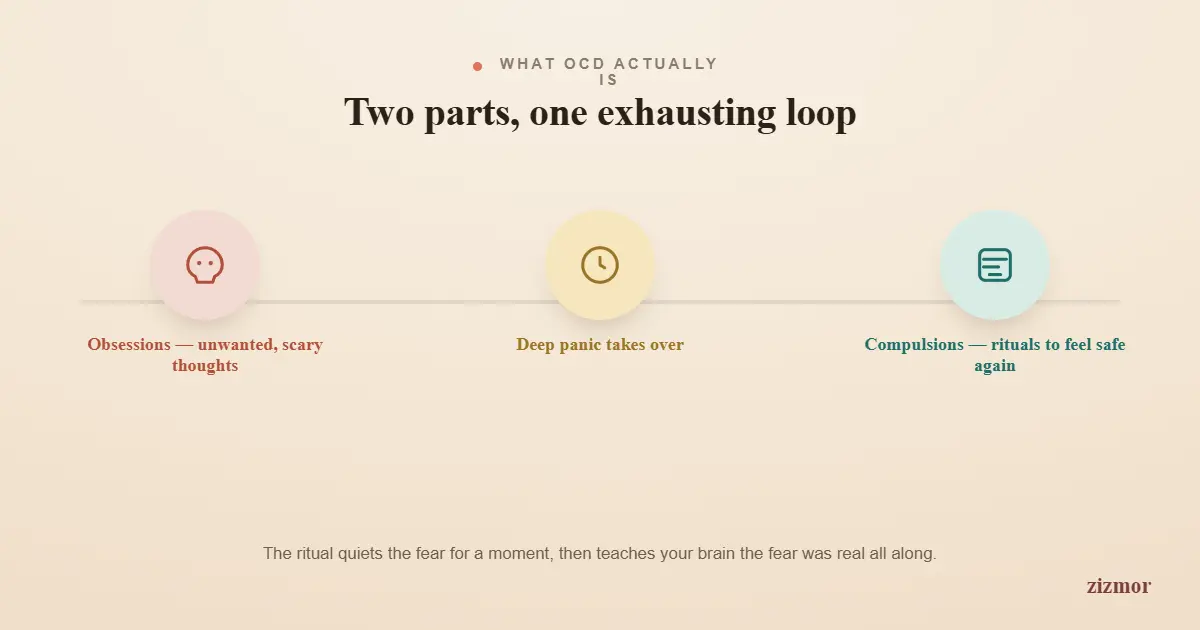
The condition has two main parts. The first part is obsessions. These are unwanted thoughts, fears, or images that pop into your mind and will not go away. They trigger deep panic and make you feel unsafe. The second part is compulsions. These are repetitive physical or mental acts that you feel forced to do. You perform these actions to quiet the scary thoughts and protect yourself.
To get an official diagnosis, you must see a trained clinical professional. A doctor will sit down with you and ask about your thoughts, feelings, and daily habits. They will check if your rituals take up a lot of time. "If your rituals consume more than one hour of your day, that is a key indicator. The doctor will also check if these loops cause you severe pain or get in the way of your work, school, and friendships. Doctors often use a scale called the Yale-Brown Obsessive-Compulsive Scale to measure how heavy your symptoms are.
How to tell if you have ocd or just habits?
Everyone has normal routines. You might check your pockets for your keys before you walk out the door. You might like to organize your shoes so they face the same way. These habits are helpful because they keep your life orderly.
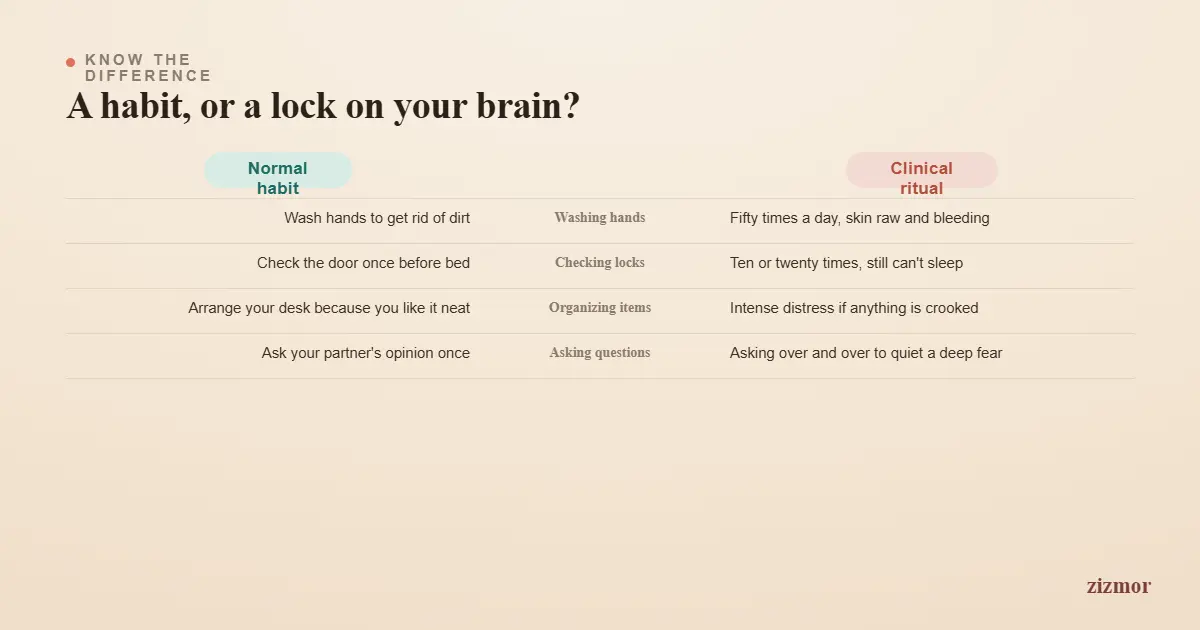
It is important to learn how to tell if you have ocd or just habits. The main difference lies in how much control you have and how much the behavior hurts your mind. A normal habit is easy to change. If you are in a rush, you can skip checking your pockets without feeling panic.
A clinical symptom feels like a lock on your brain. You cannot just stop doing it. If you try to skip the action, your chest tightens, your heart races, and you feel a wave of terror. You believe that if you do not do the action, something awful will happen to you or your family.
This table shows the difference between normal habits and clinical symptoms:
Difference between OCD and generalized anxiety disorder
You might think that all anxiety is the same. Both of these issues make you worry, and both can make your heart pound. But they are separate conditions with different features in the medical world.
Let us look at the difference between ocd and generalized anxiety disorder. We can call the second one GAD to keep things simple.
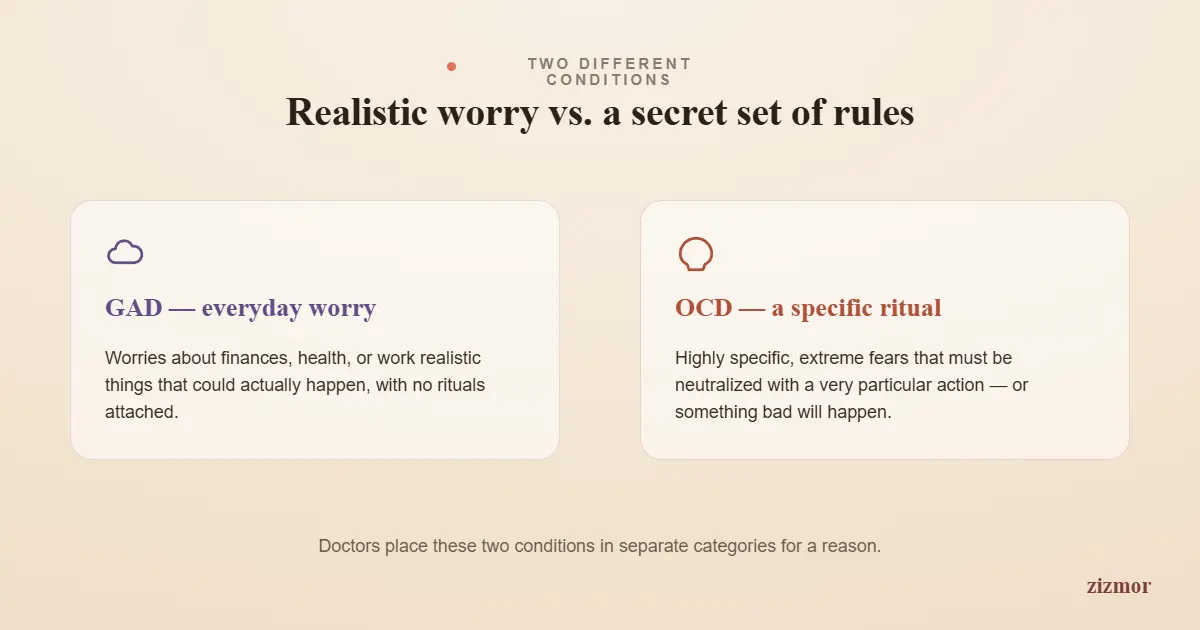
With GAD, your mind worries about normal, everyday topics. You might worry about your finances, your health, or your performance at work. These worries are realistic things that could actually happen. Pacing the room or having trouble sleeping are common signs. But you do not have a set of secret rules in your head. You do not feel forced to perform specific rituals to make the worry go away.
The other condition focuses on highly specific, extreme, or unrealistic fears. For example, you might worry that a bad thought will cause a car crash. To stop this from happening, you feel a deep urge to repeat a specific phrase or tap a table five times. This is a ritual. You perform the ritual to neutralize a very specific threat. That is why doctors place these two issues in different categories in the medical manual.
OCD intrusive thoughts examples and management
Intrusive thoughts are involuntary ideas, images, or urges that burst into your head. Almost everyone has them occasionally. A healthy mind can ignore them because they mean nothing. But if you have this condition, your brain gets stuck on them.
We will share several ocd intrusive thoughts examples and management tools to help you find relief.
Here are some common ways these thoughts show up:
- Harm Fears: You might get a sudden, terrifying image of hurting someone you love, even though you are a kind and gentle person.
- Relationship Doubts: You might constantly worry about whether you truly love your partner or if they are the "right" one for you.
- Religious Worries: You might fear that you have sinned or offended God just because a bad word popped into your head.
- Symmetry Needs: You might feel like something terrible will happen if your books are not lined up perfectly.
These thoughts do not show who you really are. They actually go against your true moral character, which is why they scare you so much.
Managing these thoughts requires a special approach. Trying to fight the thoughts or force them out of your head does not work. That just gives them more power. Instead, try to label them. When a scary thought pops up, tell yourself, "I am having an intrusive thought, and it is just noise". Let the thought sit there without doing a ritual to fix it. Over time, the panic will melt away.
OCD contamination fear treatment strategies

Fear of dirt, germs, and chemicals is very common. You might feel terrified of catching a deadly disease from a public doorknob. This fear can make you stay inside your house, avoid shaking hands, or wash your skin until it is sore.
We can share the best ocd contamination fear treatment strategies that work.
The best strategy is to face your fear slowly and safely. A therapist will help you make a list of your fears, from the smallest to the largest. You start with the easiest one. For example, you might touch a slightly dirty object, such as a shoe or a light switch.
The critical step is not to wash your hands afterward. You sit with the dirty feeling. It will feel very uncomfortable at first, and you will want to run to the sink. If you wait, your brain will slowly calm down on its own. Your mind learns that nothing terrible happened just because you touched a doorknob. This is how you break the cycle of fear.
Best therapy for ocd treatment
Many people try standard talk therapy when they feel bad. They sit in a chair and vent about their week or talk about their childhood.
But regular talk therapy does not work well for this specific issue. It can actually make your symptoms worse. When you spend your therapy hours analyzing your scary thoughts and looking for "deep meanings," you are giving those thoughts more attention. This reinforces the idea that the thoughts are dangerous.
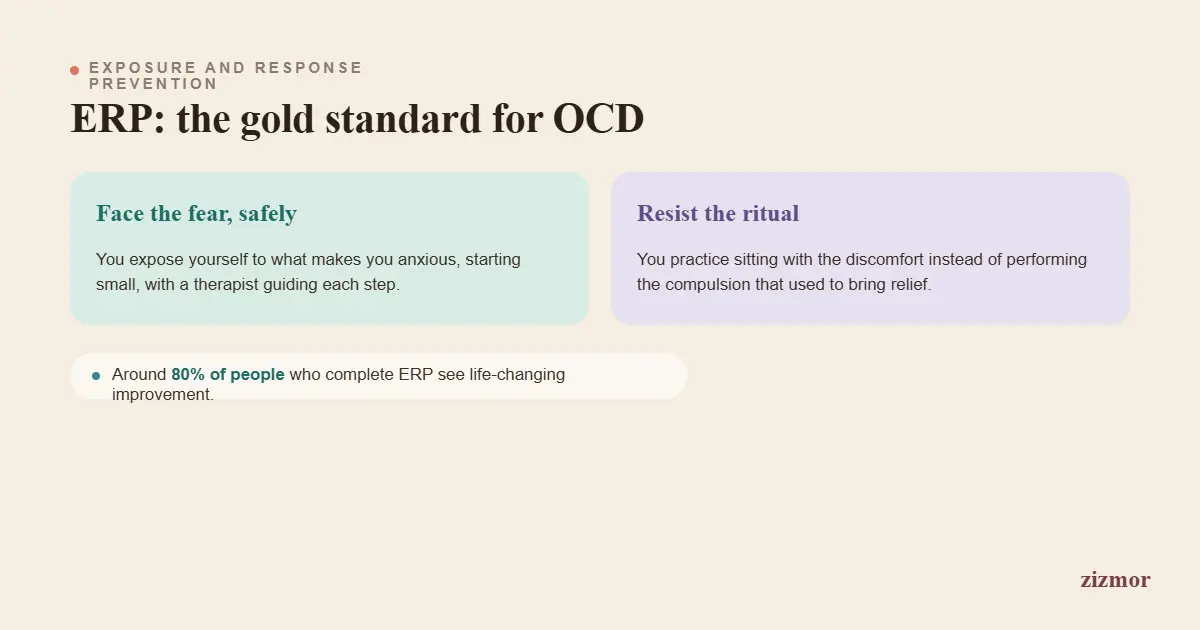
This is why you must look for the best therapy for ocd treatment. The absolute gold standard is a therapy called Exposure and Response Prevention, or ERP for short.
ERP is a highly active form of therapy. You do not just talk. You do real exercises to face your fears. You expose yourself to the things that make you anxious. Then, you practice resisting the urge to do your rituals. Around 80% of people who do ERP experience huge, life-changing improvement. It is a challenging therapy, but it is the fastest way to get your freedom back.
cognitive behavioral therapy for ocd effectiveness

ERP belongs to a larger family of therapies called CBT. We have years of scientific research demonstrating the effectiveness of cognitive behavioral therapy for OCD.
It works by changing how your brain reacts to threat signals. You cannot stop your brain from producing random thoughts. But you can choose how you respond to them.
Another helpful tool that therapists use is Acceptance and Commitment Therapy, or ACT. ACT teaches you to see your thoughts as just words, not real threats.
Therapists use some simple metaphors to explain this:
- The Loud Passengers: Imagine you are driving a school bus. Your scary thoughts are loud, angry passengers in the back. They yell at you and tell you where to go. But you are the driver. You do not have to stop the bus or fight them to keep driving to your destination.
- The Beach Ball: If you try to hold a beach ball underwater, it takes a lot of muscle. Your arms get tired, and eventually, the ball pops up and hits you. If you just let the beach ball float on the water, it will still be there, but you do not have to fight it anymore.
- Tug of War: Imagine you are pulling a rope against a scary monster over a deep pit. You pull and pull, but the monster is strong. If you just drop the rope, the struggle is over. The monster is still there, but you are free to do other things.
Medication options for ocd management
Therapy is the most powerful tool we have, but medicine can also be helpful. Some people find that taking medicine helps lower their daily anxiety so they can do their therapy homework more easily.
Let us review the medication options for ocd management.
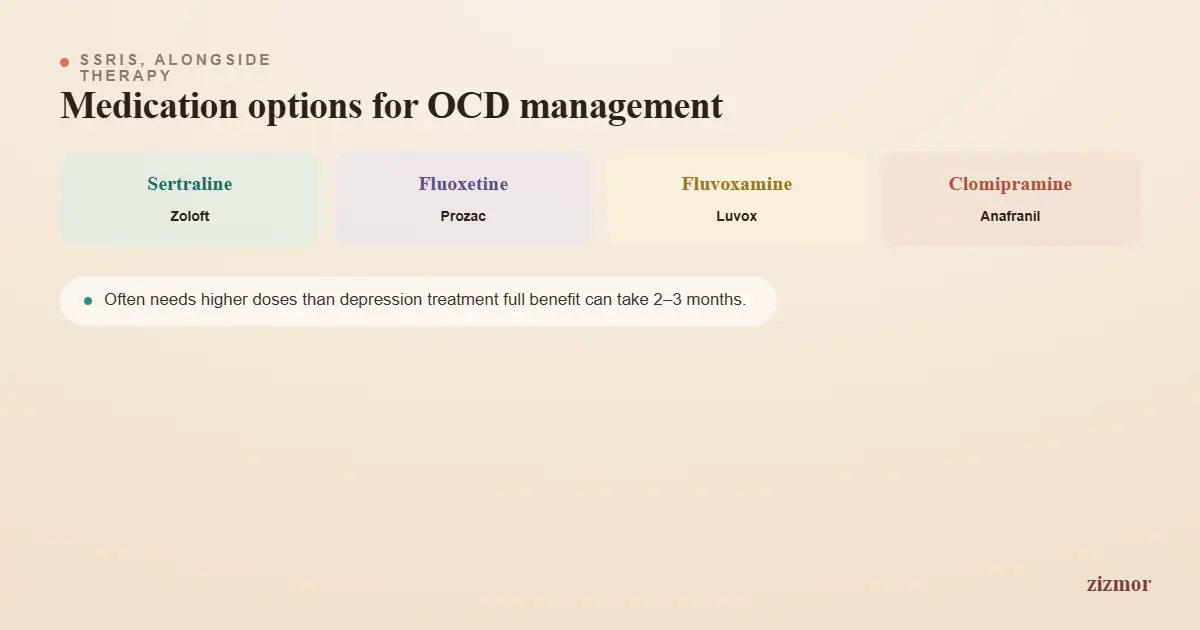
The primary medicines used are called SSRIs. These are a type of antidepressant. They help by balancing a chemical in your brain called serotonin. Serotonin plays a major role in how your brain handles worry and threat signals.
Common medicines used include:
- Sertraline (Zoloft)
- Fluoxetine (Prozac)
- Fluvoxamine (Luvox)
- Clomipramine (Anafranil)
You should know that treating this issue often requires higher doses of medicines than treating depression. It can also take two to three months to see the full benefits. These medicines can have side effects, so you must always work closely with a doctor. For young people under 25, there is a special safety warning because these medicines can sometimes increase suicidal thoughts in the first few weeks.
Can OCD be cured permanently?
This is a question we hear from almost every client who walks into our office. You want to know: can ocd be cured permanently?
The honest answer is that there is no single cure that makes it disappear forever. Doctors view it as a chronic, lifelong condition.
But that does not mean you cannot live a happy, normal life. With the right help, you can reach a state called recovery.
In recovery, the scary thoughts do not control your choices. They might still pop into your head once in a while, but they will not cause you panic. You will not feel forced to perform rituals. It is like a loud radio in the background. You might not be able to turn it off completely, but you can turn the volume down so low that you barely notice it. You can focus on your job, your hobbies, and your family again.
How to cope with ocd symptoms daily?
Working with a therapist is the most important step, but you also need tools to help you manage your symptoms at home, at school, or at work.
Here are the best ways to cope with OCD symptoms daily.
First, try to use the delay strategy. When you feel a strong urge to perform a ritual, tell yourself, "I am going to wait ten minutes before I do it." During those ten minutes, do something active. Walk around the block, listen to music, or clean a room. Often, you will find that the urge weakens or disappears completely.
Second, focus on your body. Your physical health has a huge impact on your mind. Make sure you get seven to nine hours of sleep every night. Eat balanced, healthy meals so your body has the energy to do hard things. Exercise is also a great way to lower your stress hormones.
Third, practice your therapy homework every single day. Do not avoid the situations or objects that make you nervous. The more you practice facing your fears, the stronger your brain becomes.
Self-help techniques for mild ocd
If your symptoms are not too severe, you can start with small steps on your own. There are practical self-help techniques for mild ocd that you can practice at home.
One helpful tool is journaling. Writing down your thoughts helps you spot patterns. You can keep track of what triggered your anxiety, what ritual you wanted to do, and how you managed to delay it. But be careful. Sometimes, writing things down can become a new ritual. If you feel like you must write everything down to keep from losing a memory, stop journaling and talk to a doctor.
Another tool is visualization. Close your eyes and imagine yourself facing a trigger. Picture yourself touching a doorknob or walking away from a lock. Visualize yourself feeling calm and resisting the compulsion. This helps prepare your brain for real-life success.
These tools are great starting steps. But if your symptoms are making it hard to work, go to school, or enjoy your life, you should seek professional support.
Living with someone who has ocd tips
When one person in a house has this condition, the whole family feels the stress. You might want to do anything you can to help your loved one feel better.
We have collected the best tips for living with someone who has OCD to help you build a healthy home.
You might find yourself helping your loved one with their rituals. You might wash their clothes, answer their repetitive questions, or check the locks to make them feel safe. In the medical world, we call this "family accommodation". You do it out of pure love, but it actually makes their symptoms worse over time. It teaches their brain that the fear is real.
Here is what you can do instead:
- Gently Decline Rituals: Stop participating in their checking or cleaning. You can say, "I love you, and because I want you to get better, I am not going to answer this question again."
- Involve Yourself in Treatment: Learn about ERP therapy so you can support them in doing their homework.
- Show Patience: Celebrate their small wins. Do not get angry when they have a hard day.
Support groups for ocd sufferers online
Feeling like you are the only one with these scary thoughts can make you feel very isolated. You might feel too embarrassed to talk to your friends.
You should know that there are many support groups for ocd sufferers online.
Finding a community of people who share your struggles can lift a massive weight off your shoulders. You will quickly learn that you are not alone, and your thoughts are not weird or dangerous. Other people have been exactly where you are, and they have gotten better.
You can find safe online spaces through organizations like the International OCD Foundation (IOCDF) or the NOCD community. These groups offer forums and video meetings where you can share your story without any judgment. They can help you stay motivated on your path to recovery.
OCD In children: symptoms and treatment
It is a common myth that only adults struggle with this issue. But it actually affects about 1 in every 100 children in the United States.
Let us look at ocd in children symptoms and treatment options.
In kids, the symptoms often start around age 10. It is more common in boys than in girls during childhood. It also has a strong genetic link, meaning it often runs in families.
Children might not be able to explain their thoughts. Instead, you might notice them doing repetitive actions. They might wash their hands until their skin is raw. They might line up their school supplies in a perfect line over and over. They might ask you if they are safe or if they did something wrong twenty times a day.
The primary treatment for children is age-appropriate ERP therapy. Because kids need extra support, parents play a major role in the process. The therapist will teach you how to help your child face their fears and resist rituals at home. If the symptoms are severe, a doctor might also recommend a safe medication along with the therapy.
Conclusion
Your thoughts do not show who you are. You have been fighting this battle alone for too long, but you do not have to live in fear.
We are here to help you break the cycle. Dr. Michael J. Zizmor and our team have over 40 years of experience helping people just like you take their lives back. You can learn to face your fears, silence the noise, and find real peace.
This is your moment to make a change. Do not let OCD steal another day of your life. Call us today to book your first appointment. Let us start this journey to freedom together.
FAQs
Can a strep infection cause sudden OCD?
Yes. A sudden strep throat infection can sometimes trigger rapid OCD symptoms in young children. This medical condition is called PANDAS. Do not ignore sudden, wild behavioral changes in your child. Call us immediately to get them expert help.
Is OCD officially considered a legal disability?
Yes. The government legally recognizes this condition as a disability if it stops you from working. You do not have to struggle in silence while your life falls apart. Let us help you rebuild your strength today.
Can drinking coffee make OCD symptoms worse?
Yes. Caffeine is a strong stimulant that can trigger a physical panic response in your body. It fires up your brain’s alarm system, making scary thoughts feel much more urgent. Protect your peace and call us to start healing.
Can doctors use brain scans to diagnose OCD?
No. Brain scans reveal altered neural pathways, but doctors cannot use them to diagnose you. A physical scan cannot read your painful thoughts. Only a professional psychological evaluation can set you free. Schedule your clinical assessment with us today.
Does pregnancy trigger postpartum OCD spikes?
Yes. Huge hormonal shifts and major life changes can trigger terrifying intrusive thoughts about your newborn child. Do not let shame keep you from being a happy parent. Reach out to us now for safe, supportive medical guidance.