How To Explain ADHD to Your Employer: Navigate the Conversation Confidently

Table of Contents
- What is the Big Decision? should I tell my employer I have ADHD?
- What Are the Best ADHD at work disclosure strategies?
- What Are Your legal rights ADHD in the workplace?
- Practical Communication: how to explain ADHD to your employer
- Can You Get ADHD accommodations at work without telling boss?
- How to request ADHD accommodations at work
- Take Action and Protect Your Career Today
While you read these words, someone is losing their job. They did not want to fail. They just missed one too many deadlines. They got lost in their unread emails. Or they zoned out during a major team meeting.
This is not because they do not care. It happens because they are fighting their own brain.
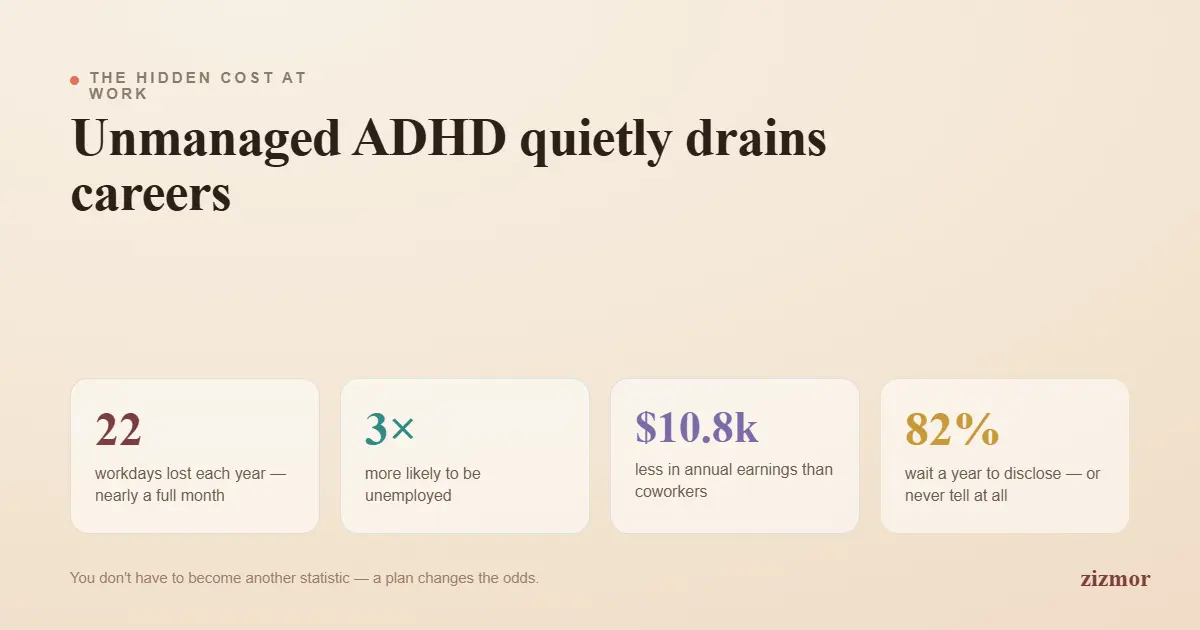
Recent data shows that adult ADHD is rising fast among working professionals. Over 15 million adults in the United States have ADHD today. According to the World Health Organization, adults with ADHD miss an average of 22 workdays every single year. That is almost a full month of lost work. If you have ADHD, you are three times more likely to lose your job.
On top of that, a study from Harvard Medical School shows that adults with ADHD earn over ten thousand dollars less per year than their coworkers. You do not have to become another statistic. You can protect your job, your income, and your peace of mind.

We write this guide with the trusted, real-world experience of Dr. Michael J. Zizmor. He is a mental health physician licensed to practice medicine in California (Physician's and Surgeon's License G50848, NPI 1124395421) who has spent over forty years helping people understand their minds. Dr. Zizmor started his path at the University of California, Berkeley, where he earned his undergraduate degree in Psychology. He then went to the University of Kansas School of Medicine to earn his medical doctorate. He completed his clinical internship at Boston University-affiliated hospitals and began psychiatric residency training at St. Elizabeths Hospital in Washington, DC; he is not board-certified in psychiatry. Dr. Zizmor believes that understanding how your mind works is the first step toward feeling better, and he's here to help you look at the facts clearly. We will show you exactly how to explain ADHD to your employer so you can work with confidence.
What is the Big Decision? should I tell my employer I have ADHD?
Adult ADHD is a real medical condition. The Mayo Clinic defines adult ADHD as a mental health disorder. It includes persistent problems like difficulty paying attention, hyperactivity, and impulsive behavior. These symptoms can lead to poor work performance, low self-esteem, and stressful relationships.
Unmanaged ADHD at work can make you feel like you are barely getting by. You might work extra hours but still fall behind. You might copy work that is already done, send wrong files, or miss deadlines. This is not a lack of effort. It is a brain issue. But if your boss does not know, they might think you are lazy.
This is why you face a huge question: should I tell my employer I have ADHD?
Many professionals hide their struggles due to fear or shame. In fact, 82% of workers with ADHD either wait at least a year to tell their boss or do not tell them at all. The rise of remote and hybrid work has made the gap wider. Working from home removes the physical structure of the office. This makes time management much harder. When these struggles become visible, you face a critical choice.
Analyzing the pros and cons of telling your boss about ADHD
Making this choice requires weighing the pros and cons of telling your boss about ADHD. Let us look at both sides clearly.
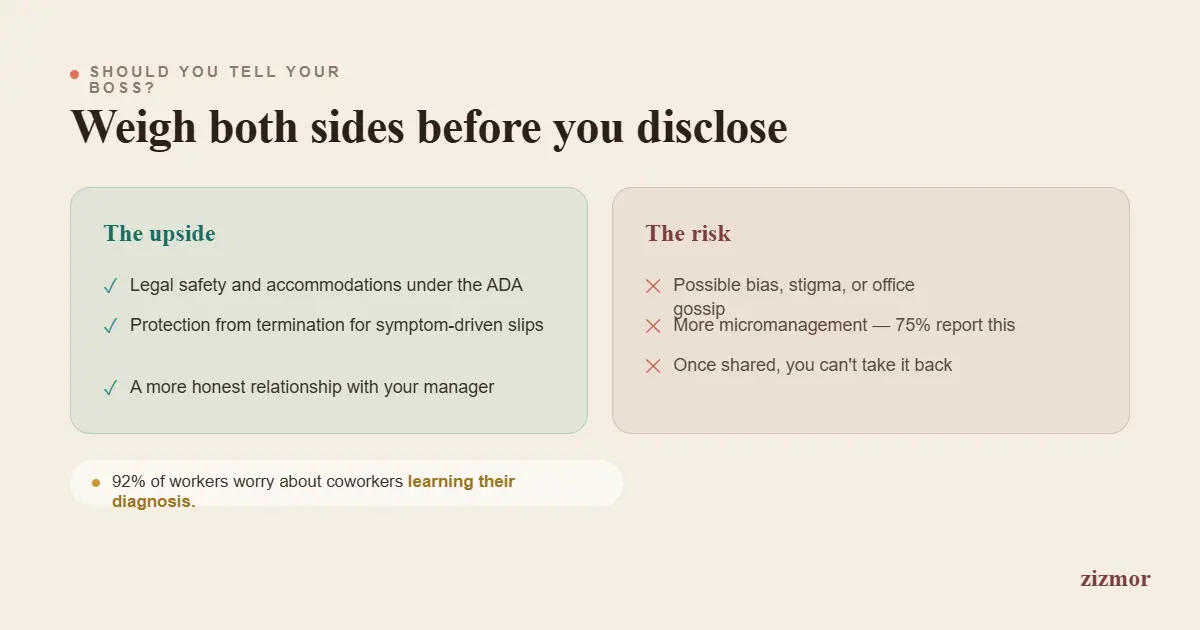
Sharing your diagnosis can open the door to helpful resources. You can get specialized coaching or a modified schedule. It also provides a shield of legal protection under federal law. This prevents sudden terminations based on performance issues that stem from your medical condition.
But there are also real risks. Sharing these sensitive details can lead to subtle bias, gossip, and unfair treatment.
Many supervisors do not understand neurodiversity. They can confuse a lack of focus with a lack of effort. Research shows that 92% of employees worry about their coworkers learning about their diagnosis. On top of that, 75% of employees with ADHD report experiencing increased micromanagement by supervisors relative to their peers. If your workplace has a poor track record with mental health, keeping your diagnosis private is often the safest path.
What Are the Best ADHD at work disclosure strategies?
When deciding how to share your diagnosis, you must evaluate different ADHD at work disclosure strategies. Clinical experts note that ADHD is often the worst kept secret in the office. This means that even if you do not say you have ADHD, your actions can let the cat out of the bag. Supervisors quickly notice missed deadlines, messy desks, or a lack of attention in meetings.
One effective strategy is to discuss symptoms before diagnoses. This means talking about specific focus needs with a manager without sharing a formal medical label. You can ask for a quiet desk or written instructions simply because it helps you work faster. This approach solves the problem without triggering any underlying myths about mental health conditions.
Your value to the company also plays a major role in these decisions. A highly valued worker with a strong track record is much less likely to suffer negative consequences when asking for help. The overall employment rate in your industry is another factor to consider. If your skills are rare and in high demand, your employer will be highly motivated to provide tools to keep you.
Tips for disclosing ADHD to boss without discrimination
The primary goal of disclosing ADHD to boss without discrimination is to secure needed changes while protecting your career. To achieve this, the conversation must focus entirely on performance, strengths, and business solutions.
You should avoid framing the discussion around weakness or personal struggle. Instead, present accommodations as tools that unlock higher productivity and better results.
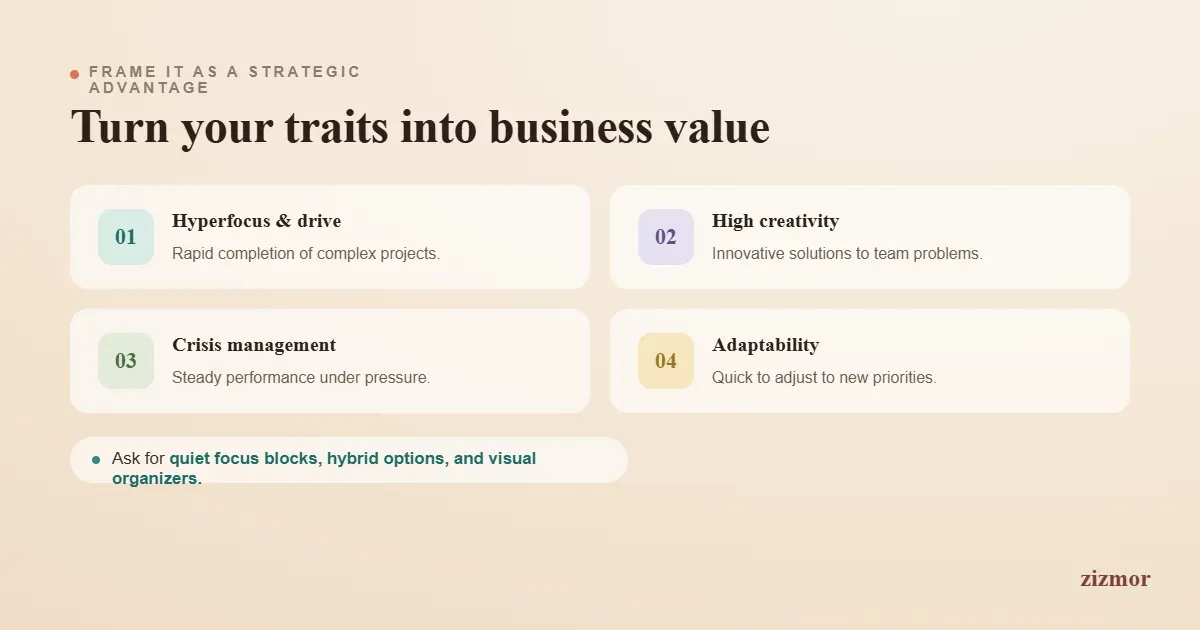
Highlighting your unique strengths is highly effective during these discussions. People with ADHD often possess exceptional creativity, problem-solving skills, and the ability to hyperfocus on topics of interest. By showing your manager how these traits benefit the company, you can shift the focus from a medical limitation to a strategic advantage.
What Are Your legal rights ADHD in the workplace?
Your legal rights ADHD in the workplace are protected under Title I of the Americans with Disabilities Act, also known as the ADA. The ADA covers both autism and ADHD as qualifying disabilities.
These protections only apply to employers with 15 or more employees. A diagnosis alone does not automatically trigger ADA protections. Your condition must substantially limit a major life activity, such as your ability to concentrate, think, or work. This is generally a low bar for most adults with ADHD, but it is an important step to establish with HR.
Under the ADA, a reasonable accommodation is any change to a job or work environment that allows you to do your job effectively without causing undue hardship to the employer. The employer is not required to eliminate essential job functions, lower quality standards, or provide indefinite leave. They must engage in a good-faith interactive dialogue to find an effective solution.
Key benefits of disclosing ADHD to HR
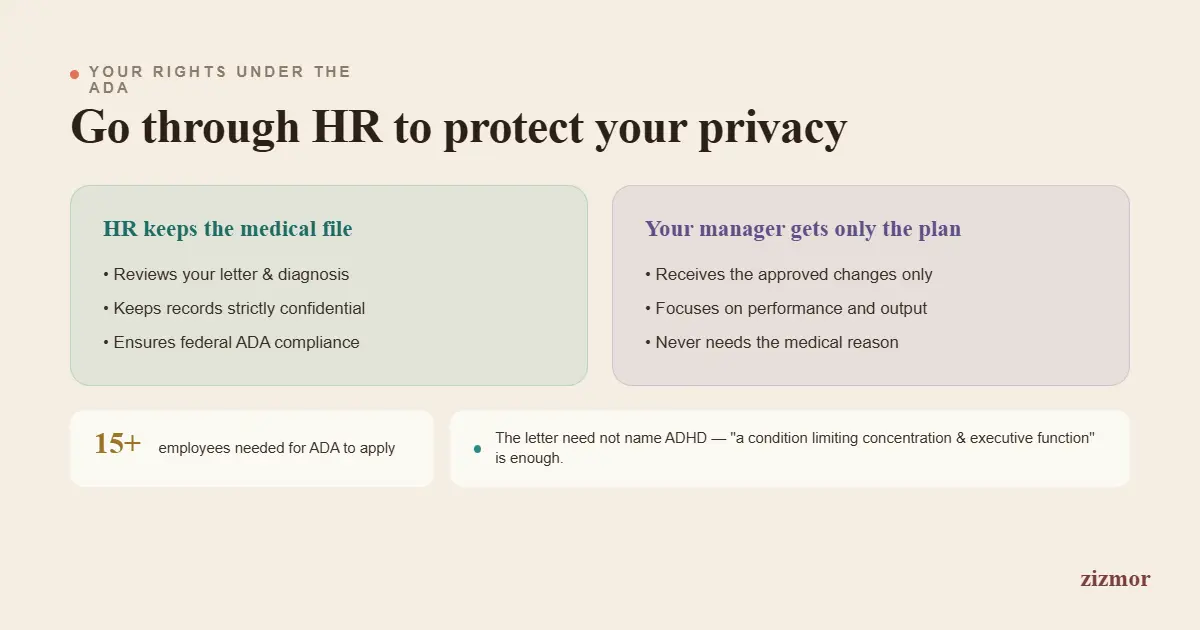
There are major benefits of disclosing ADHD to HR rather than speaking directly to a manager. The primary benefit is medical privacy.
Federal law requires HR to keep all medical records strictly confidential. These documents must be stored in a secure file separate from your regular personnel folder.
This information separation prevents a supervisor's personal biases from affecting your performance reviews. The manager is only told what changes must be implemented, such as a modified schedule or a quieter workspace. They are not entitled to know the underlying medical reason unless you choose to share it.
Step-by-Step: explaining ADHD symptoms to HR
The process of explaining ADHD symptoms to HR is highly structured and follows two main steps.
First, you must notify HR that you need a workplace adjustment due to a documented medical condition.
Second, you must provide supporting documentation from a qualified medical provider.
Your clinician's letter does not need to name ADHD specifically. It is legally sufficient to describe your condition as a chronic neuropsychiatric impairment that limits concentration and executive function. This documentation protects your privacy while securing your legal rights.
Practical Communication: how to explain ADHD to your employer
When planning how to explain ADHD to your employer, it helps to understand how the brain's management system operates. This system is called executive function. It acts like an office manager inside your head, helping you plan, stay focused, and finish tasks.
When stress or a condition like ADHD strains this system, simple office chores can feel genuinely overwhelming. This is not a character flaw or a sign of laziness. It is a physical difference in how the brain processes information. Explaining this mechanism simply helps employers understand what supports are needed.
Easy Ways of explaining adult ADHD symptoms to a non-ADHD boss
When explaining adult ADHD symptoms to a non-ADHD boss, you must overcome common misconceptions. Many people still believe that ADHD is just an inability to sit still or a lack of self-discipline. Over 92% of workers say their colleagues hold these wrong assumptions.
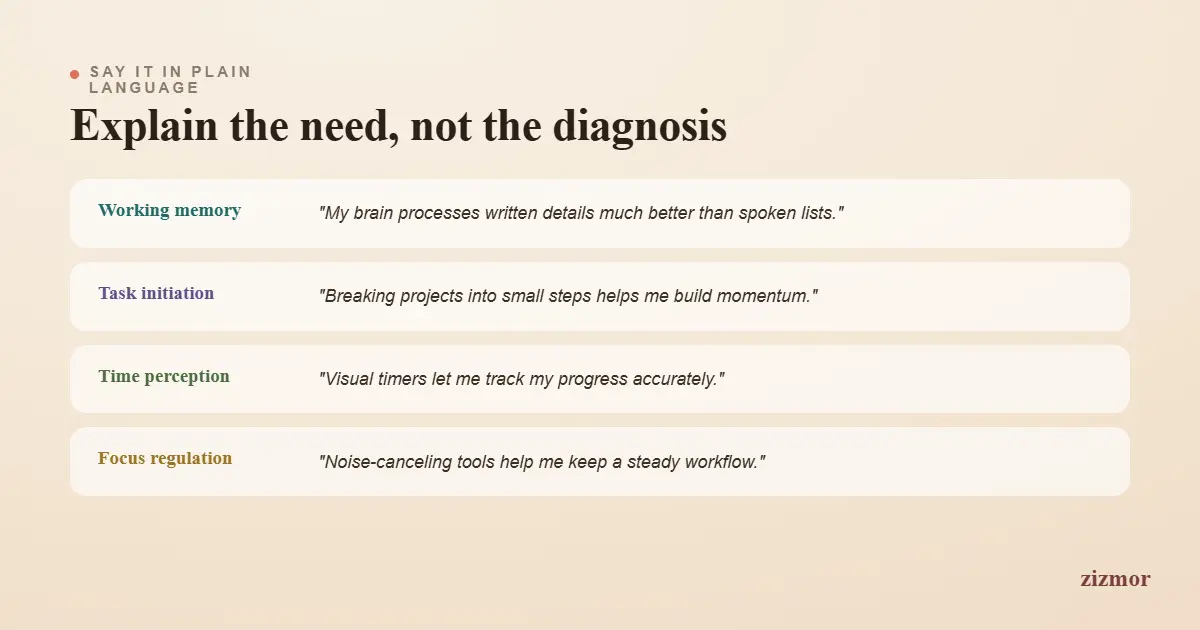
To bridge this gap, focus on functional language. Describe how you process information and what tools help you maintain a high level of performance. Avoid complex clinical terms and explain your brain's needs using simple, everyday examples.
Help! talking to manager about ADHD performance issues
If performance issues have already been raised, talking to manager about ADHD performance issues requires a proactive and honest approach. Acknowledge the specific issues, such as a missed deadline or a disorganized report, and immediately connect them to a concrete workflow solution.
Taking ownership of your behavior without over-apologizing demonstrates professional maturity. Show your manager that your goal is to build a more reliable and efficient workflow.
Practical tips for discussing ADHD with manager
To ensure a successful conversation, keep these tips for discussing ADHD with manager in mind:
- Schedule a private, uninterrupted meeting when you have plenty of time to talk.
- Focus entirely on productivity and how the requested changes will benefit the team.
- Come to the meeting with two or three realistic, low-cost suggestions for changes.
- Follow up the discussion with a brief email to summarize the agreed-upon steps.
Realistic scripts for telling employer about ADHD
Having a clear script helps you stay calm and confident. Use these scripts for telling employer about ADHD to guide your meeting:
Script 1: Starting a General Conversation about Strengths
"Thank you for meeting with me. I want to talk about how I can do my absolute best work in this role. I have ADHD, which is a medical condition that impacts my executive function and focus. It gives me great strengths, like solving complex problems fast and working well under pressure. But it also means I process information much better when it is written down rather than spoken. I would like to write a quick email to confirm our project goals after our weekly meetings. This small change will help me deliver consistent, high-quality work."
Script 2: Dealing with Performance Issues Proactively
"I want to follow up on our talk about the late report last week. I have ADHD, which impacts my ability to track time, sometimes called time blindness. I take full ownership of the delay, and I have built a new plan to prevent this from happening again. I would like to do a quick five-minute check-in with you every Tuesday to review my project steps. This clear structure will help me stay on track and hit our deadlines on time."
Script 3: Requesting Workspace Changes
"I am finding it hard to stay focused because of the noise in our open office. My ADHD makes it very difficult for my brain to block out background chatter, which slows down my work speed. To help me work more efficiently, I would like to use noise-canceling headphones during my morning focus hours. This simple tool will help me block out distractions and finish my tasks much faster."
Can You Get ADHD accommodations at work without telling boss?
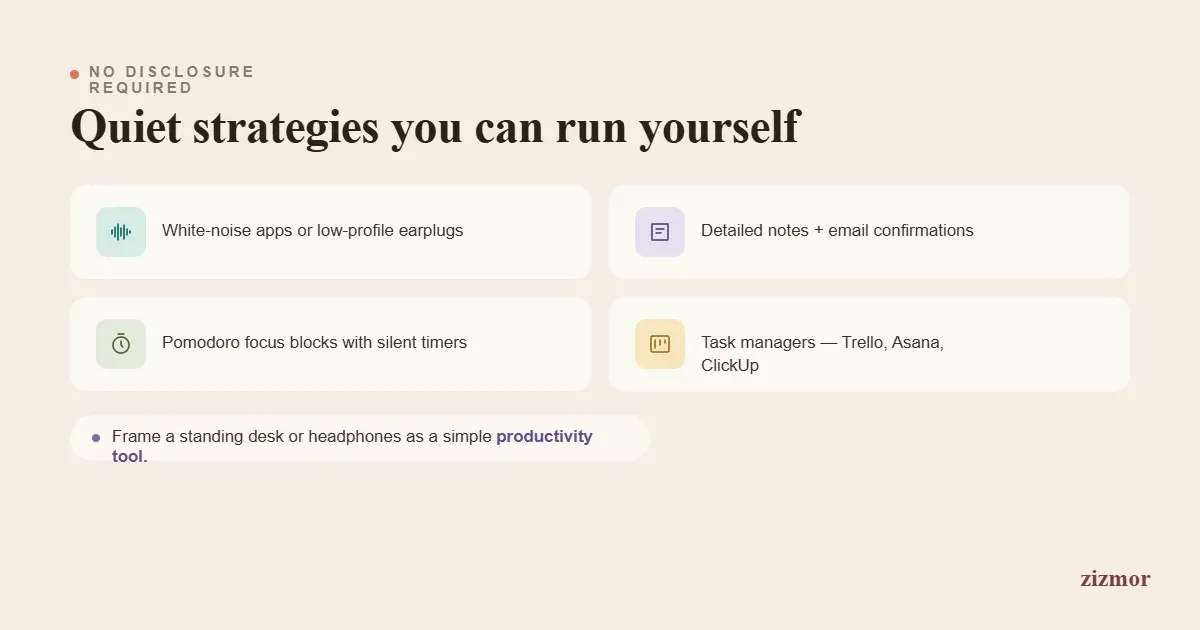
Securing ADHD accommodations at work without telling boss is a highly effective way to protect your personal privacy. Many helpful adjustments can be requested under the umbrella of general productivity or wellness. This approach allows you to get what you need without initiating a formal medical process.
For example, asking for a standing desk can be framed as a way to improve physical posture and reduce back strain. Requesting to wear noise-canceling headphones can be described simply as a personal strategy to maximize concentration during complex tasks. Most managers are happy to grant these simple requests if they see an increase in the quality and speed of your work.
Simple Tips for managing ADHD symptoms at work discreetly
For professionals who prefer to keep their diagnosis completely private, managing ADHD symptoms at work discreetly is often the best choice. There are many subtle strategies you can implement without supervisor approval.
These self-managed supports build a highly reliable structure for your brain. They allow you to perform at a high level while keeping your medical history private.
How to request ADHD accommodations at work
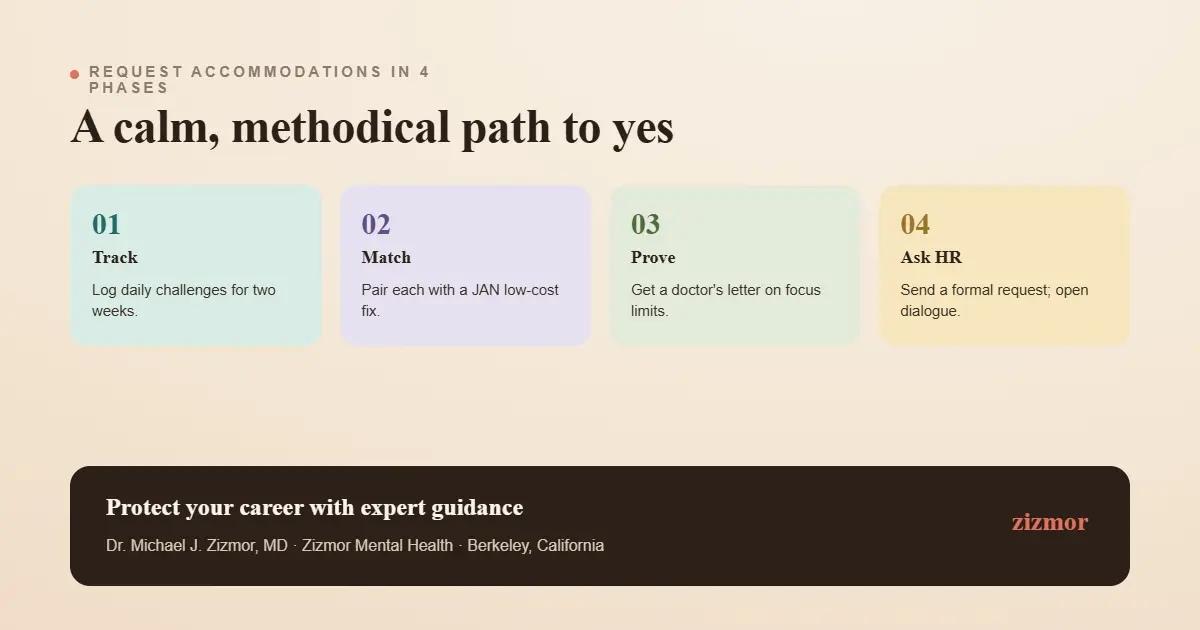
If self-managed strategies are not enough, developing a formal plan for how to request ADHD accommodations at work is the next logical step. You should approach the process methodically to ensure the best possible outcome.
Begin by tracking your struggles. Note when your focus dips, what causes distractions, and when tasks are missed. Once these patterns are clear, match each challenge with a proven, low-cost accommodation. This preparation ensures your request is grounded in practical solutions rather than vague complaints.
ADHD disclosure letter to employer sample
When submitting a formal request, using a written letter is the best way to establish a clear legal paper trail under the ADA. Use this ADHD disclosure letter to employer sample as a starting template:
Date: October 24, 2026
To: Human Resources Department, Apex Global Solutions
From: Jordan Smith, Operations Specialist
Subject: Formal Request for Reasonable Accommodations under the ADA
Please accept this letter as a formal request for reasonable workplace accommodations under Title I of the Americans with Disabilities Act. I have a documented medical condition that affects executive functioning, concentration, and working memory, which limits my ability to maintain sustained focus in open-plan office environments.
To help me perform the essential functions of my position at the highest level, I am requesting the following reasonable accommodations:
- Environmental Support: Relocating my desk to a quiet, low-traffic area of the office, or permission to work remotely up to three days per week.
- Auditory Distraction Mitigation: Authorization to use high-quality, active noise-canceling headphones during core deep-work hours.
- Structured Working Memory Supports: A requirement that all key project directives and task hand-offs be provided in writing or logged in our digital project management platform.
I have attached supporting documentation from my clinical provider that outlines my functional limitations and confirms my need for these specific adjustments. I look forward to engaging in the interactive dialogue process to discuss how we can implement these strategies to support my ongoing performance and success.
Sincerely,
Jordan Smith
Crucial resources for employees with ADHD and their employers
Navigating the disclosure and accommodation process is much easier when utilizing established resources for employees with ADHD and their employers. These organizations provide free, expert guidance to ensure the accommodation process is positive, structured, and legally compliant.
Take Action and Protect Your Career Today
Living with ADHD at work can feel like a silent, exhausting battle. But you do not have to struggle in secret or worry about losing your job. Now you know how to explain ADHD to your employer in a way that protects your career and helps you do your best work.
Take a deep breath. Gather your documents, use the scripts, and talk to HR or your manager with quiet confidence. You have the talent, you have the legal rights, and you have a clear plan. It is time to thrive
FAQs
Must you disclose ADHD during job interviews?
No. You have the right to keep your medical history completely secret. Do not risk bias before they see your talent. Focus only on your skills, win the job, and request accommodations after your first day.
Will ADHD ruin your government security clearance?
No. Having this diagnosis or taking your prescribed medication will not disqualify you. The government cares about your honesty and stability, not your neurodiversity. Be honest, stay compliant with your doctor, and secure your career safely today.
Do independent contractors get ADA workplace protections?
No. Federal laws protect regular employees, but they do not cover freelance workers. You must build your own custom schedule and tools. Take charge of your workflow today to keep your clients happy without relying on corporate HR.
Can your boss demand your full medical files?
No. Your employer has no right to dig through your private records. They can only request a basic doctor's note proving your focus needs. Protect your privacy, say stop to nosy bosses, and handle this strictly through HR.
Must you pay for your own accommodations?
No. Your employer must cover the cost of your approved workplace tools. Most adjustments cost nothing at all. Do not spend your own hard-earned money. Demand your legal rights and let the company invest in your daily success today
This article is for general information only. It is not a substitute for individual medical advice. For guidance specific to your situation, please contact our team or start an intake to speak with a clinician.