Is ADHD A Disability For Work Accommodations?
In This Article
- Yes, ADHD Is a Disability for Work Accommodations
- FMLA Leave Policies: Can I Get FMLA for ADHD in the Workplace?
- The Big Choice: What Are the Pros and Cons of ADHD Disclosure at Work?
- A Step-by-Step Blueprint: How to Request ADHD Accommodations at Work
- Real-World Changes: Finding Reasonable Accommodations for ADHD at Work ADA Style
- Written Templates for Your Accommodation Request
- To Wrap It Up: Is ADHD a Disability for Work Accommodations?
You're waking up every single morning with a heavy weight in your chest. You look at your phone and see fifty unread emails. Your calendar is packed, and your to-do list seems to grow on its own. You already feel behind before your feet even touch the floor. You try as hard as you can, but your brain just will not cooperate.
You are not lazy, and you are not broken. Your brain is simply wired differently.
If you do not take action today, you might become part of a scary statistic. A massive study by Harvard Medical School shows that the average worker with ADHD loses over 22 days of productive work every single year. That is almost a whole month of your life, pay, and peace of mind gone. On top of that, you are three times as likely to be fired or become unemployed as the person sitting next to you.
Untreated ADHD costs the US economy up to 266 billion dollars a year. Do not let yourself be another number in a spreadsheet. You have the power to turn this around right now, save your career, and stop the panic. The first step is simple. You need to know: is ADHD a disability for work accommodations?
We are going to give you the exact blueprint to protect your job and get your focus back.
We are writing this guide with Dr. Michael J. Zizmor, a mental health physician with over 40 years of experience. He started his journey at the University of California, Berkeley, where he earned his undergraduate degree in Psychology to understand how the human mind works. He went on to get his medical doctorate at the University of Kansas School of Medicine. After that, he completed his internship at Boston University-affiliated hospitals and his psychiatric residency training at St. Elizabeths Hospital in Washington, DC. Dr. Zizmor has spent decades helping people navigate work struggles, and he knows the exact legal and medical steps to get you the support you deserve. Let us dive in.
Yes, ADHD Is a Disability for Work Accommodations

Let us look at the federal laws that protect you. The main shield you have is a law called the Americans with Disabilities Act of 1990, or the ADA for short. This law is very clear about your rights.
Under the ADA, you have protection if you live with a physical or mental issue that makes it hard to do major life activities. What are major life activities? They are basic, daily things like walking, seeing, or hearing. But they also include brain tasks. The law explicitly covers concentrating, thinking, learning, and focusing.
If your ADHD makes it hard to do these tasks, you are covered.
In 2008, Congress made this law even broader. They told the courts and employers to protect as many people as possible. They made sure the test to qualify for help isn't super hard to pass.
So, your boss cannot just look at you and say, "You seem fine, so you do not get help."
Even if you take medicine like stimulants and feel better, the law looks at how you are without your pills. That means you still have ADHD workplace accommodations legal rights. Your rights are real and protected by federal law.
Your boss cannot fire you for asking for help. They cannot treat you poorly, cut your hours, or pass you over for promotions just because you asked for changes. But you have to speak up. The law does not protect you if you keep your struggles a secret.
Let us look at how this works in real life.
What Are the Rights of Employees with ADHD in the Workplace?
You have the right to equal treatment from the moment you apply for a job. This is the core of the law.
If you are looking for work, a company cannot refuse to hire you just because you have ADHD. They cannot ask you about your medical history during an interview, and they cannot ask if you take mental health medications. That is highly illegal.
Once you are on the job, you have the right to ask for changes that help you do your work. These changes are called reasonable accommodations.
A reasonable accommodation is a small tweak to your workspace, your tools, or your schedule. It helps you do your job well. It does not mean you get to do less work, nor that you can ignore your main duties. It simply levels the playing field so you can perform at your best.
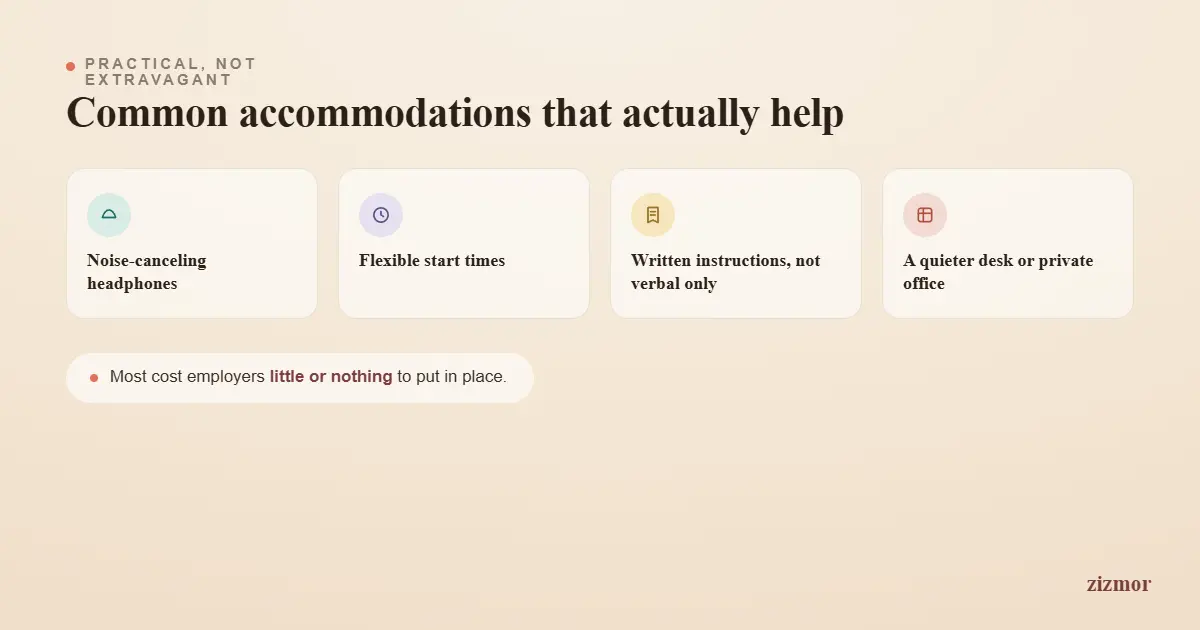
For example, if your office is too loud and you cannot focus, you have the right to ask for a quiet desk. If you struggle with verbal lists, you have the right to ask for written instructions. Your boss must work with you to find a solution. This is one of the most important rights of employees with ADHD in the workplace.
How Does ADHD Legally Qualify as a Disability Under the ADA?
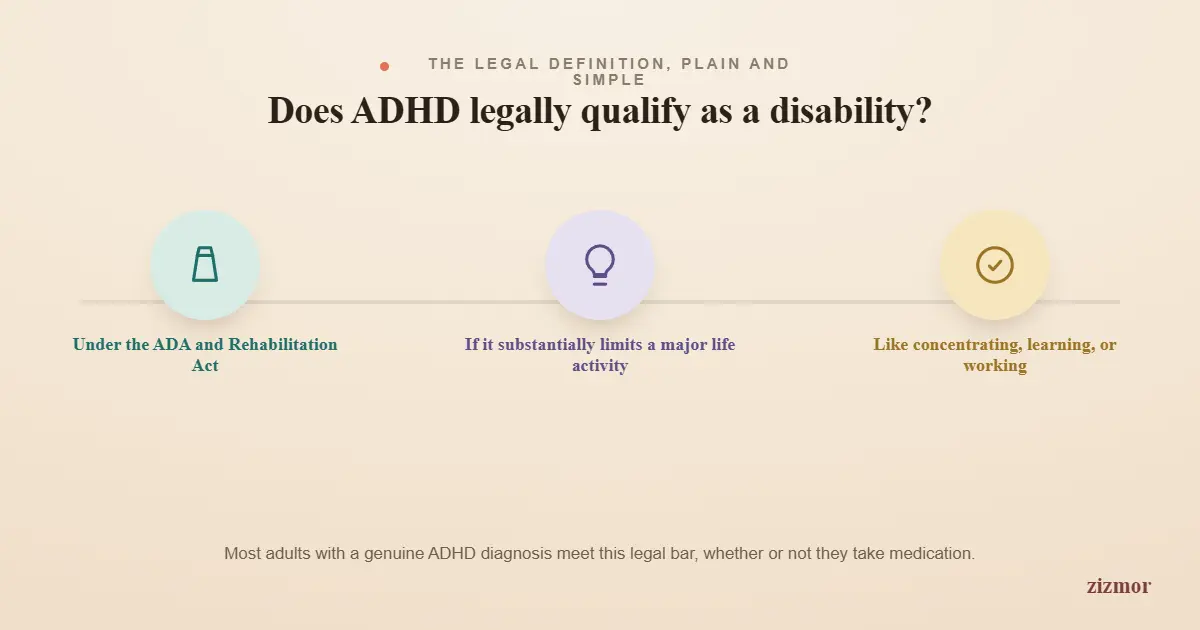
To get help, your issue must substantially limit you. That sounds scary and official, but it is not a hard test to pass.
The law says "substantially limit" does not mean you are completely unable to work. It just means you have a much harder time with daily tasks than the average person.
Think about how your brain works. ADHD is a brain-based issue. It is not a character flaw or a lack of effort. It affects how your brain uses dopamine, which is the chemical that helps you focus, start tasks, and track time.
When your brain lacks enough dopamine, you get stuck. You might stare at a screen for hours, unable to start a simple task. You might get distracted by every little sound in the room.
Because this affects your thinking, concentration, and ability to work, it meets the legal definition of a disability.
Your doctor can write a simple letter to prove this. Once you share that letter, your employer must listen. This is part of ADHD as a disability under ADA protections.
Is ADHD Considered a Hidden Disability for Employment Success?
Yes, it is. When people ask, is ADHD considered a hidden disability for employment, the answer is a big yes.
Unlike a physical issue, no one can see your ADHD. You do not use a wheelchair, and you do not have a cast. You look perfectly fine on the outside, which makes things very tricky.
When you make a mistake, your boss might think you do not care. They might think you are lazy, careless, or irresponsible.
Mayo Clinic notes that missing deadlines and forgetting tasks are core ADHD signs. But to a boss who does not know about your brain, it just looks like bad work.
This is why hidden disabilities are so hard to handle. You are fighting a massive battle in your head every single day, but everyone else just sees the surface.
Understanding this helps you see why formal help is so important. It gives your struggles a name and a legal shield. It stops people from guessing and protects your job.
FMLA Leave Policies: Can I Get FMLA for ADHD in the Workplace?
Sometimes, a small daily change at your desk is not enough. You might feel so burned out, stressed, or overwhelmed that you need to step away from work to get your health back on track.
So, you might ask: Can I get FMLA for ADHD in the workplace?
Yes, you can.
The Family and Medical Leave Act of 1993, or FMLA, is a federal law that allows you to take up to 12 weeks of unpaid leave each year for health reasons.
Your job is fully protected while you are gone. They cannot give your spot away, and they cannot fire you for taking leave.
To get FMLA, you must work for a company with 50 or more employees within 75 miles of your job site. You also need to have worked there for at least a year and logged at least 1,250 hours.
Your ADHD must qualify as a "serious health condition." This means you are getting ongoing treatment from a doctor, therapist, or psychiatrist. If you are struggling with severe anxiety or depression alongside your ADHD, which is very common, that also helps you qualify.
One great thing about FMLA is that you do not have to take all 12 weeks at once. You can take "intermittent leave." This means you can take a few hours off a week for therapy or doctor visits. Or you can take a day off when your symptoms are too severe to handle.
Let us look at how the ADA and FMLA differ. We have put together a simple table to show you.
| Feature | ADA | FMLA |
|---|---|---|
| Main Goal | Helps you stay at work with daily support. | Lets you take time away from work to heal. |
| Company Size | 15 or more employees. | 50 or more employees within 75 miles. |
| Time Allowed | No set limit, depends on your needs. | Up to 12 weeks per year. |
| Pay Status | You keep working and get your normal pay. | Unpaid, but you can use your saved PTO. |
| Job Security | Protects you from being fired for needing help. | Guarantees you get your exact job back when you return. |
The Big Choice: What Are the Pros and Cons of ADHD Disclosure at Work?
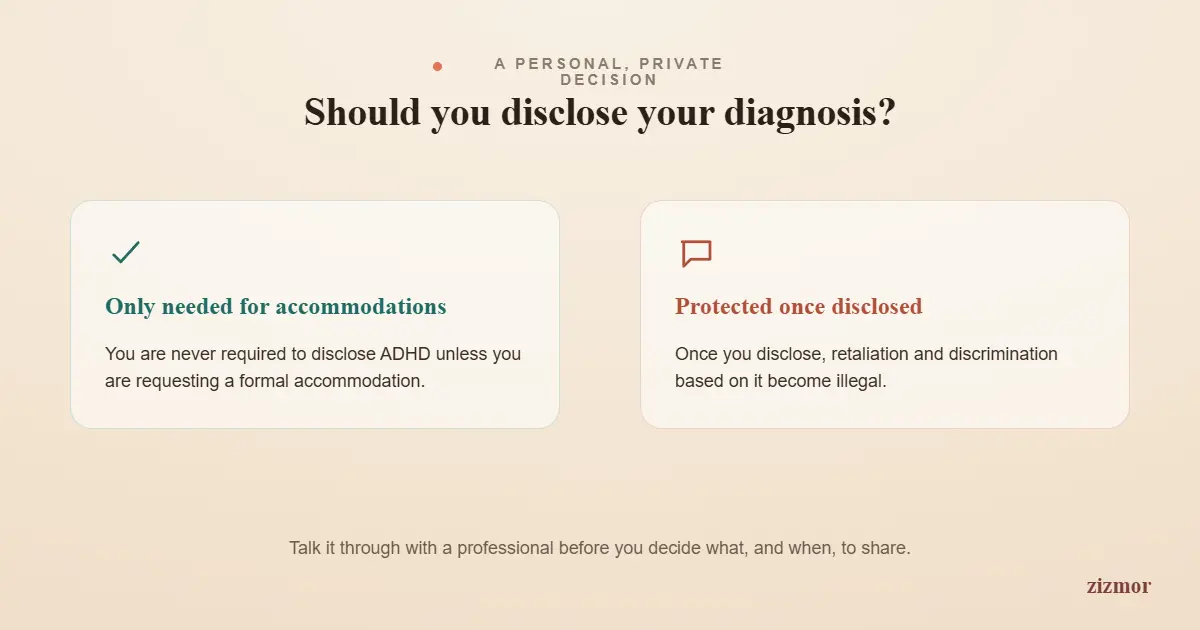
Sharing your diagnosis with your boss is a very personal choice. There is no single right answer for everyone. You have to weigh the risks and the rewards.
Let us look closely at the pros and cons of disclosing ADHD at work so you can make the best decision for your career.
The biggest pro is legal safety. Once you tell Human Resources and provide a doctor's note, you are protected under the ADA. Your boss cannot fire you for performance issues that your accommodation is meant to fix.
Another pro is peace of mind. You do not have to hide anymore. You do not have to make up excuses for why you wear headphones, need a quiet spot, or take extra time to finish a report.
The biggest con is stigma. Some bosses do not understand ADHD. They might treat you differently once they know. They might think you cannot handle big projects, or they might micromanage your work.
Remember, disclosure is a one-way street. Once you tell them, you cannot take it back.
If your ADHD is mild and you can handle your job with your own tricks, you might not need to say a word to your boss. But if your job is in danger, telling them is often your best move. It forces the company to stop, listen, and help you instead of just letting you go.
What Documentation Is Needed for ADHD Work Accommodations?
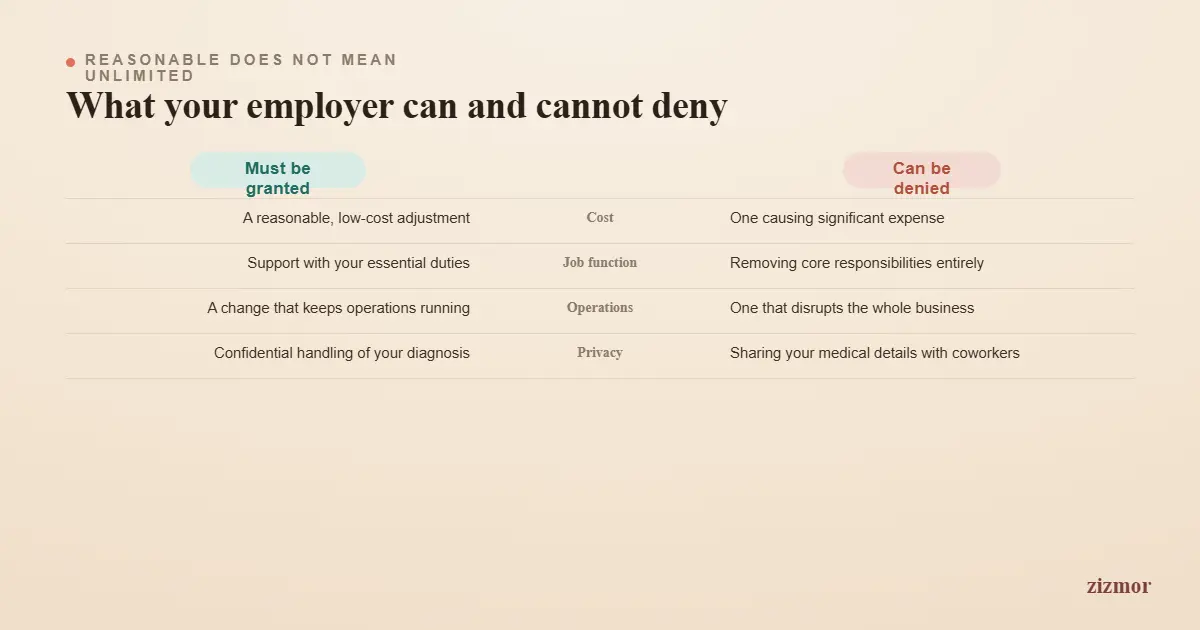
If you decide to ask for help, you need proof. You cannot just walk in and say you have ADHD. Your company has the right to ask for official documentation. But they do not have the right to look at your entire medical file. That is a huge rule to remember.
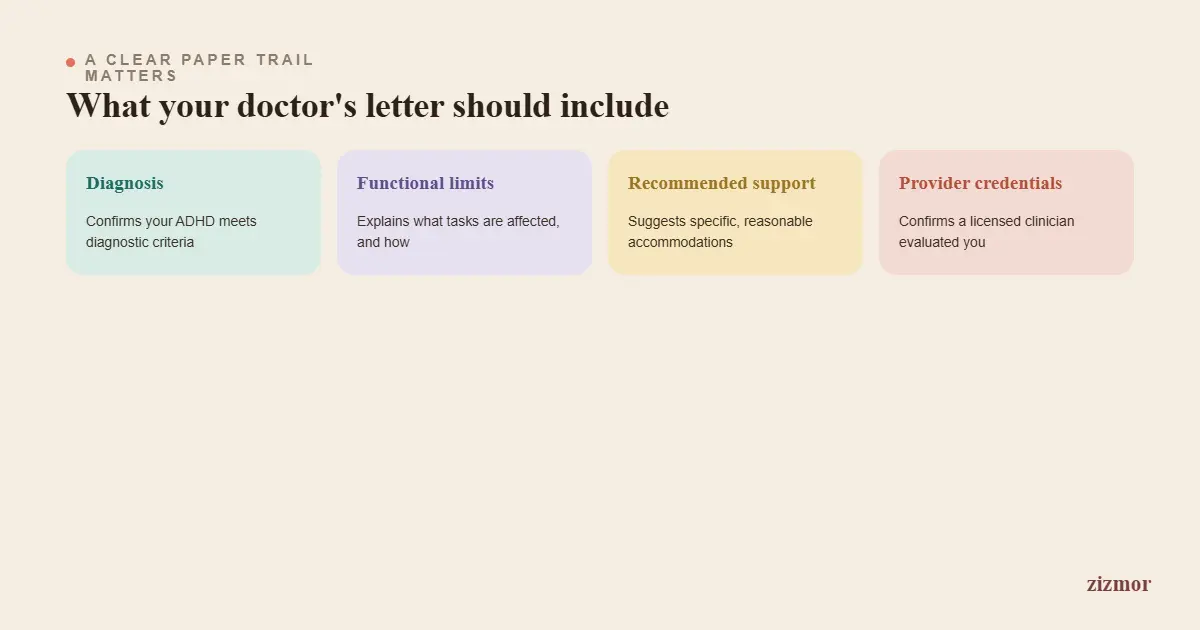
The documentation needed for ADHD work accommodations is usually just a simple letter from your doctor or therapist. This letter needs to state three basic things:
First, it must confirm you have a diagnosed medical condition that counts as a disability under the law. Second, it must explain how this condition limits your work. For example, it might say you struggle with noise, time management, or task organization. Third, it must suggest specific changes that will help you do your job.
You can keep the clinical details private. Your doctor can use phrases like "a chronic neurological condition" instead of naming ADHD if you prefer to keep the exact label hidden. This keeps your private details safe while still giving you full legal rights.
How to Talk to Your Boss about ADHD Accommodations Without Fear
Speaking to your manager can feel scary. Your heart might race just thinking about it. But you can make this conversation easy if you prepare beforehand.
When you learn how to talk to your boss about ADHD accommodations, the golden rule is to focus on your productivity, not your struggles. Do not make it sound like you are complaining or asking for special favors. Frame it as a way to make you a superstar employee.
Instead of saying, "My ADHD makes it impossible to focus in this loud office," try a positive approach.
Say, "I want to make sure my reports are 100% accurate. I have found that I am much more focused and productive when I work in a quiet spot or use noise-canceling headphones. Can we set that up as a formal change?
This shows your boss that you care about your output. It makes it very easy for them to say yes.
A Step-by-Step Blueprint: How to Request ADHD Accommodations at Work
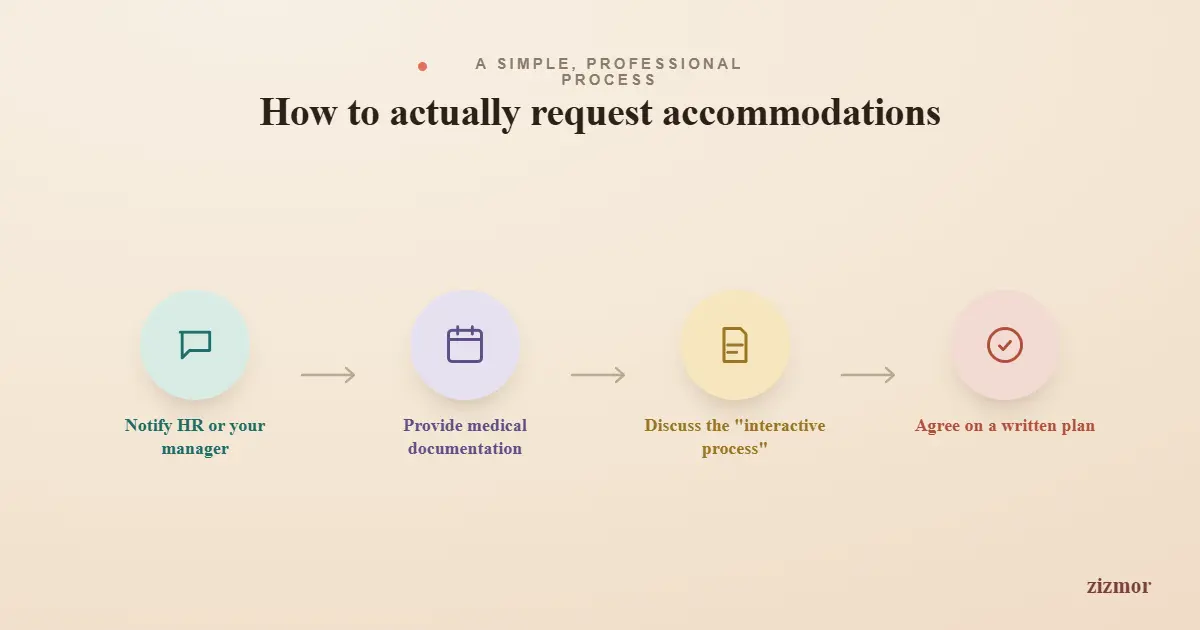
Do not just wing it. Follow a clear plan to protect yourself. Let us look at how to request ADHD accommodations in a four-step process.
Step One: Write it down. While you can ask in a meeting, having a paper trail is much safer. Write a polite email to Human Resources or your boss. Step Two: Hand over your doctor's note. This gives your request legal teeth and starts the official process. Step Three: Talk it out. Meet with HR or your manager. Be ready to negotiate. They might suggest different ideas, and that is okay. Step Four: Get the final plan in writing. Do not rely on a verbal promise. If your boss leaves the company, your informal deal might vanish. A written record protects you long-term.
Let us look at a simple table to show the steps and why they matter.
| Step | What You Do | Why It Matters |
|---|---|---|
| 1. Written Request | Send a formal email to HR or your manager. | Starts the legal paper trail and proves you asked for help. |
| 2. Medical Note | Give them a simple letter from your doctor. | Shows you have a real medical need under the ADA. |
| 3. Joint Meeting | Talk about which changes will help you best. | Lets you work together to find a solution that works. |
| 4. Written Agreement | Sign a document showing the agreed changes. | Protects your changes even if you get a new boss. |
What Are the Essential Employer Obligations for ADHD Accommodations?
Your boss has clear rules they must follow. These are called employer obligations for ADHD accommodations.
First, they cannot ignore your request. Once you ask for help, they must talk to you in good faith to find a solution. Second, they must keep your medical information private. They cannot tell your coworkers about your diagnosis or your accommodations. Third, they must provide a change that works, unless it causes "undue hardship."
What is undue hardship? It means the change would be way too expensive or ruin the business.
For example, a small local shop might not be able to build a brand new private office for you. That would cost too much. But they could let you wear earplugs or move your desk to a back corner.
On the other hand, a massive company cannot easily claim a few hundred dollars is too expensive.
What Qualifies as a Reasonable Accommodation for ADHD in Your Daily Tasks?
You might wonder: what qualifies as a reasonable accommodation for ADHD? It is simply any change that is realistic, does not cost a fortune, and helps you do your core duties. It is not a free pass to miss work or skip projects.
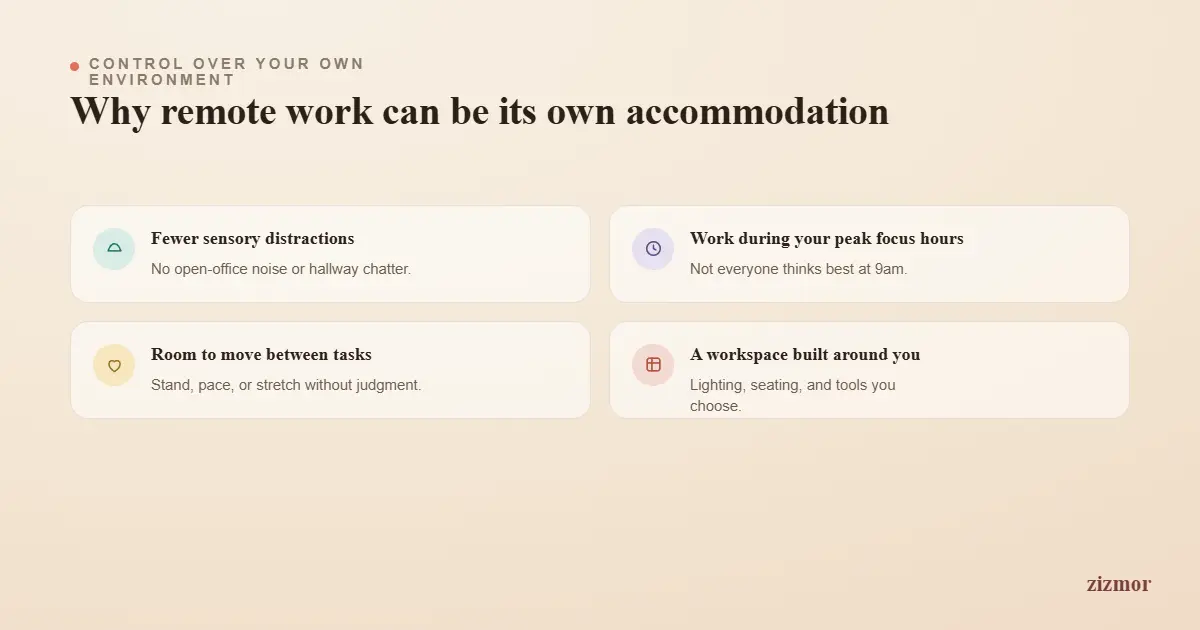
It can be as simple as a noise-canceling headset or a desk in a quiet room. It could be a flexible schedule so you can work when your brain is most active.
It could also be having your manager send meeting notes in writing instead of just telling you.
Most changes cost nothing. A study found that 58% of accommodations cost the company $0. When companies do spend money, it is usually around 400 to 500 dollars. This is a tiny price to pay to keep a great employee.
Real World Changes: Finding Reasonable Accommodations for ADHD at Work ADA Style
Let us look at some real-world examples of how to make your workday easier. When you request reasonable accommodations for ADHD at work, ADA guidelines are your best friend. These changes are meant to tackle the areas where your brain gets stuck.
For instance, if sensory overload is your main battle, ask for visual barriers or permission to use white noise machines. If you struggle with starting tasks, ask for structured daily check-ins with your team. If you get physically restless, ask for a standing desk or a chair that lets you move.
Let us look at how you can use these changes every single day.
How to Use ADHD Executive Function Workarounds Daily
Accommodations are great, but you also need personal strategies to win. We call these ADHD executive function workarounds.
Executive function is like the conductor of your brain's orchestra. When you have ADHD, the conductor falls asleep. To wake them up, you need visual and sensory cues.
Try using a physical timer on your desk. Watching the time tick down helps your brain understand "time blindness."
Break your big tasks into tiny, bite-sized pieces. Do not write "Finish Project" on your to-do list. That will scare your brain and cause procrastination. Instead, write "Open draft," "Write three sentences," or "Find two sources."
Use brightly colored sticky notes to remind you of your main goals. Put them where you cannot ignore them. These tiny tricks help you bypass your brain's blocks.
Smart Workplace Strategies for ADHD Management That Keep You Focused
Let us talk about daily habits. You can build excellent workplace strategies for ADHD management to regain control of your day.
First, control your phone and computer notifications. Turn off all non-urgent alerts. If you see a red bubble, your focus is gone for at least twenty minutes.
Second, try using "body doubling." This is working alongside someone else, even if you are both silent. It helps your brain stay anchored to the task.
Third, schedule short movement breaks. Mayo Clinic suggests that movement can boost focus for people with ADHD. Walk to the water fountain or stretch for two minutes every hour.
These strategies keep your energy high and stop your brain from checked out daydreaming.
What Are the Best Jobs for Adults with ADHD Who Need Accommodations?
Not all jobs are built the same way. Some roles are a nightmare for ADHD brains, while others are a perfect match.
When searching for the best jobs for adults with ADHD who need accommodations, look for roles with variety, high energy, and clear goals. Jobs that require you to sit in a cubicle doing the exact same task for eight hours are very hard.
You will likely do much better in active roles. Think about careers in emergency services, sales, teaching, creative arts, or hands-on trades. These jobs offer quick feedback and keep your brain engaged.
If you are in a desk job, make sure it has clear project cycles rather than endless, unstructured tasks.
Let us compare different job types in a simple table.
| Job Type | Why It Works for ADHD | Challenges to Watch For |
|---|---|---|
| Active / Hands On | Lots of movement, keeps you physically engaged. | Can have less structure or physical risks if you lose focus. |
| Creative / Fast Paced | Novelty keeps dopamine high, encourages outside the box thinking. | Meeting strict deadlines or managing client files. |
| Structured Desk Jobs | Clear routines can help you stay on track. | Sitting for too long, repetitive tasks can cause boredom and burnout. |
Written Templates for Your Accommodation Request
We want to make this as easy as possible for you. Here are two template letters you can copy, edit, and use right now.
Clinician Documentation Template
March 3, 2026
To: Human Resources / Accommodations Administrator
Employer: Meridian Software Group
Employee Name: Jordan Ellis
Date of Birth: 14 June 1990
Re: Request for Reasonable Accommodations under the ADA for Jordan Ellis
To Whom It May Concern,
I am the treating clinician for Jordan Ellis. I have been treating this patient since 9 January 2025. Jordan Ellis has a diagnosed neurodevelopmental condition that constitutes a disability under the Americans with Disabilities Act and its 2008 Amendments.
Specifically, this chronic neuropsychiatric condition impairs executive functioning, affecting prefrontal cortex operations. This impairment substantially limits several major life activities, including concentrating, thinking, organizing, and processing information.
In the employee's professional role as a Marketing Coordinator, these executive function deficits present specific operational barriers:
High distractibility in open-concept sensory environments disrupts cognitive focus. Short-term working memory challenges, making it difficult to recall complex, multi-step verbal instructions. Time blindness, which can interfere with prioritizing tasks and managing long-term deadlines.
To enable Jordan Ellis to perform the essential functions of their position effectively, I recommend the following reasonable accommodations:
Placement of their desk in a quiet, low-traffic area of the office, or permission to use noise-canceling headphones during focused work blocks. Providing written summaries, visual checklists, or email confirmations of all critical tasks and verbal instructions. Breaking down large, complex projects into smaller phases with structured, intermediate deadlines.
These modifications are intended to help Jordan Ellis manage their symptoms and perform at their full potential. They do not represent a request to lower performance standards. I anticipate these accommodations will be needed indefinitely.
Please contact me at 217 555 0148 or r.nguyen@example.com if you require additional clinical clarification.
Sincerely,
Dr. Rachel Nguyen
Dr. Rachel Nguyen, PsyD, Licensed Clinical Psychologist
License PSY 24681, State of Illinois
Employee Accommodation Request Letter
March 3, 2026
To: Human Resources Department / Alicia Ferreira
Company Name: Meridian Software Group
Address: 482 Lincoln Avenue, Springfield, IL 62701
Subject: Request for Reasonable Accommodation under the ADA
Dear Human Resources Team,
I am writing to formally request reasonable accommodations under the Americans with Disabilities Act and its 2008 Amendments. I have a documented medical condition that affects my executive functioning, particularly my ability to maintain concentration, process verbal information, and organize unstructured tasks.
I am fully capable of performing the essential functions of my role as a Marketing Coordinator. However, my current workspace and workflow structure present specific barriers to my daily productivity. To help me perform at my best and deliver high-quality work, I am requesting the following reasonable accommodations:
Workspace Location: Moving my desk to a quieter, low-traffic area of the office, or permission to use noise-canceling headphones during periods of focused work. Task Communication: Receiving written checklists or brief email summaries following our weekly project meetings to confirm task details and priority lists. Workflow Support: Structuring large, long-term projects into smaller phases with clear, intermediate deadlines.
I have attached a letter from my healthcare provider outlining my functional limitations and confirming the practical need for these accommodations.
I welcome the opportunity to discuss these options with you during our interactive dialogue. My goal is to find practical solutions that support my productivity and contribute to the team's success. Thank you for your time and support.
Sincerely,
Jordan Ellis
Jordan Ellis
Marketing Department, Ext. 204
To Wrap It Up: Is ADHD a Disability for Work Accommodations?
So, where do we stand? When you ask yourself, is ADHD a disability for work accommodations, the answer is a clear yes.
You do not have to drown in stress, suffer through burnout, or live in constant fear of losing your job. The law protects your right to ask for simple, life changing adjustments that help you succeed.
Dr. Michael J. Zizmor wants you to remember that your brain is not broken, it is just unique. With the right workspace and a clear plan, you can unleash your true potential and thrive.
Do not wait until your boss calls you in for a performance review. Take the first step today. Speak to your doctor, gather your papers, and start the conversation. You deserve to work in a place that helps you shine.
FAQs
Do part-time workers get ADHD accommodations?
Yes. The law protects you even if you work just a few hours. Do not let your boss ignore your struggles. Grab your medical note and claim your legal rights today. You deserve a setup built for your brain.
Can your boss force you to take meds?
No. Your employer can never dictate your personal medical decisions. Do not let them control your body. If they threaten you, document everything and call a lawyer immediately. Stand your ground and protect your health right now.
Do remote employees get ADA protections?
Yes. Working from your living room does not cancel your federal rights. Do not suffer in silence at home. Draft your written request today and demand the exact software tools you need to stop your daily work panic.
Can I request a different boss as help?
No. Courts usually say changing your supervisor is not a reasonable change. But do not give up hope. Request a meeting today to modify how you get feedback. Take charge of your career path and schedule that talk now.
Does HR share your ADHD with coworkers?
No. Your company must keep your medical files strictly locked away. Do not let fear of gossip paralyze you. Take back your power, trust the law, and secure your job right now by submitting your private doctor note.
This article is for general information only. It is not a substitute for individual medical advice. For guidance specific to your situation, please contact our team or start an intake to speak with a clinician.