7 Subtle ADHD Symptoms Adult Women You Might Be Missing

Table of Contents
- The Hidden Signs: Why Subtle ADHD Symptoms Adult Women Experience Go Unnoticed
- Did You Have These Childhood Clues?
- Is Your Racing Mind Actually ADHD Inattentive Type Symptoms Adult Women Experience?
- What Are the Masking Habits We Use to Hide?
- How Does Constant Masking Lead to Burnout?
- What Is the Real Impact on Your Daily Tasks?
- What Do Attention Struggles Look Like at Work?
- Why Are Your Moods on an Endless Rollercoaster?
- Are You Treating the Wrong Condition Due to ADHD and Anxiety Overlap in Women?
- Why Is ADHD Misdiagnosis in Adult Women So Common?
- What Happens to Older Women Facing Menopause?
- Can You Reclaim Your Life After Late Diagnosis ADHD Symptoms Women Receive?
- Why Does Your Partner Feel Ignored?
- How Do We Actually Build Better Habits?
- Moving Forward with Confidence
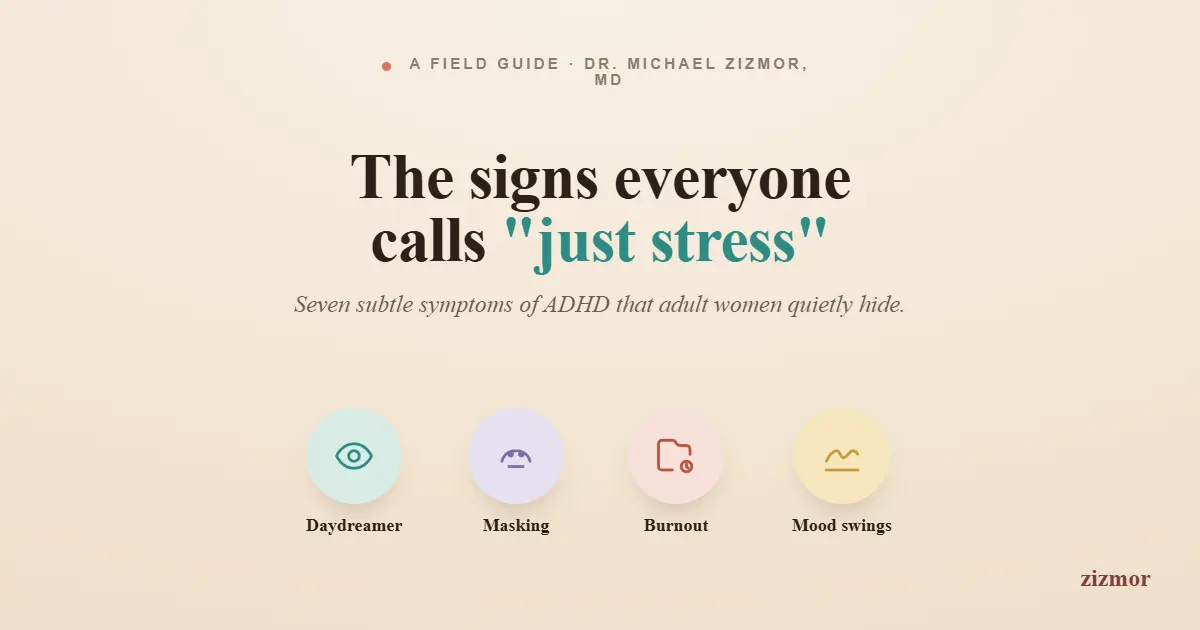
For a very long time, doctors thought only hyperactive little boys had ADHD. They expected to see kids running around classrooms, climbing trees, and breaking rules. Because of this old view, science left girls behind. Now we know that girls do not usually act out in public. Their struggle is quiet and stays inside their minds.
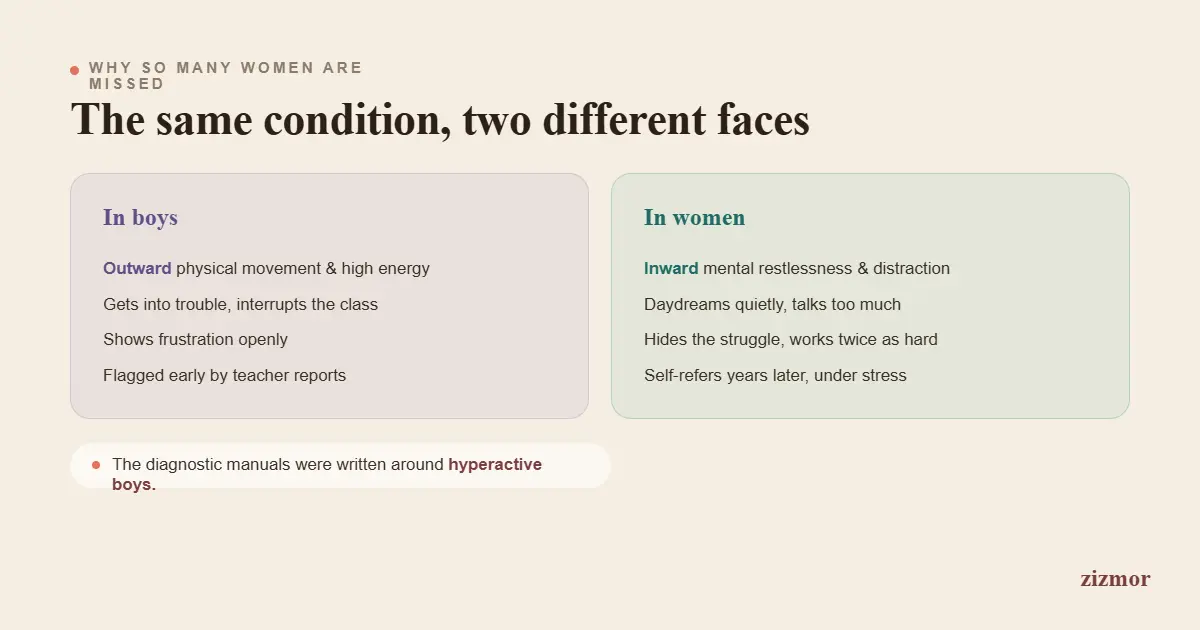
If we want to understand how adhd presents differently in adult females, we must look past physical restlessness. Instead of running around, a woman might have a mind that never stops talking to itself. She might look perfectly calm on the outside, but her brain is running a marathon.

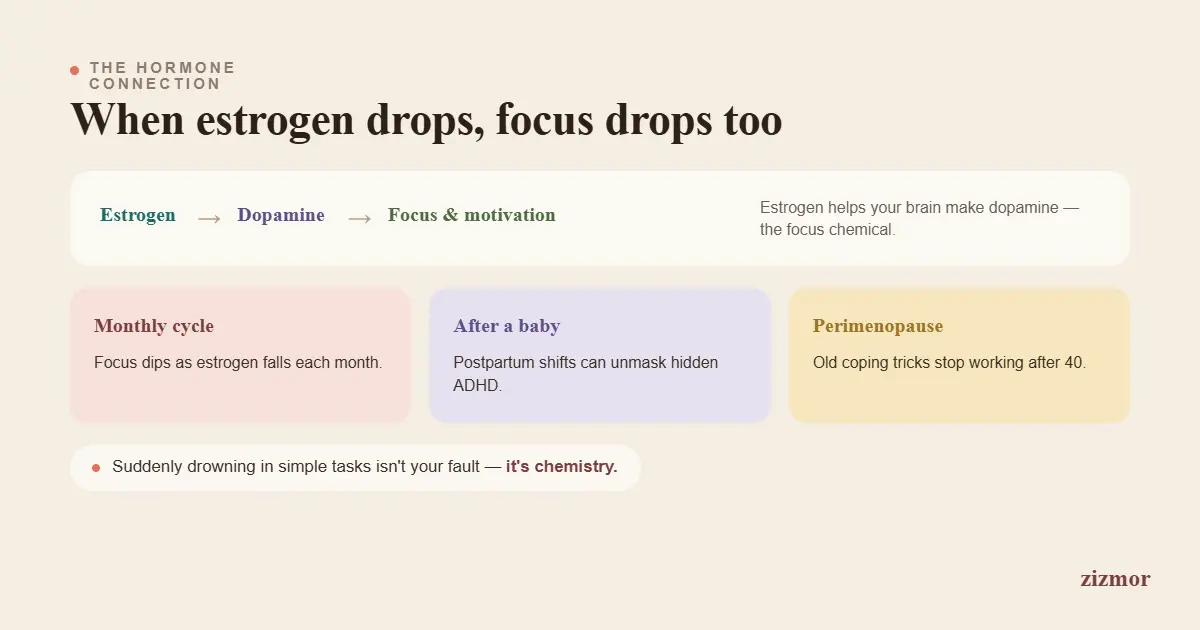
Your hormones also make a massive difference. Estrogen helps your brain make dopamine. Dopamine is the chemical that helps you focus and feel motivated. When your estrogen levels drop during your monthly cycle, your focus can drop too. This also happens after you have a baby or when you go through menopause. Suddenly, the tricks you used to keep your life organized stop working. You feel like you are drowning in simple tasks.
Let us compare how boys and girls show these signs. This helps us see why so many women are missed.
Did You Have These Childhood Clues?
When you were a little girl, did people call you a daydreamer? Did teachers write on your report card that you had so much potential if you only tried harder? These are early adhd indicators in adult women. Girls are very good at hiding their struggles because they want to please their parents and teachers. They do not want to cause trouble. They sit quietly at their desks, but their minds are miles away. They might talk very fast or lose their toys constantly. Because they do not disrupt the class, nobody notices their pain. They carry this hidden stress into adulthood.
Many girls develop a deep sense of shame early in life. They see other kids organize their desks and finish homework easily. They try their best, but they still lose their pencils and forget their books. Since they look quiet and polite, teachers assume they are just not interested or are being lazy. This misunderstanding leaves a scar. You grow up believing that you are fundamentally flawed, rather than simply having a brain that is wired differently.
On top of that, young girls with ADHD often face social troubles. They might talk too much or interrupt their friends. Other kids might pull away from them. This rejection hurts deeply. To protect themselves, these girls start watching others very closely. They copy how neurotypical girls talk, play, and organize their lives. They build a perfect mask to hide their confusion. This constant act helps them fit in, but it leaves them feeling empty and incredibly tired.
Is Your Racing Mind Actually ADHD Inattentive Type Symptoms Adult Women Experience?
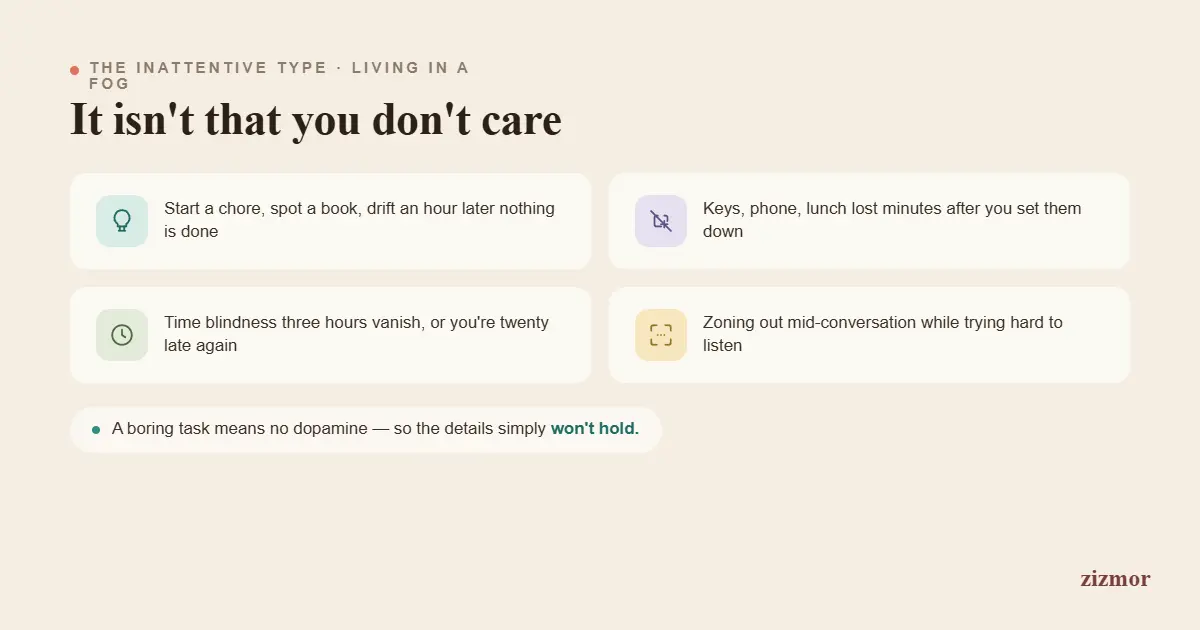
Many women do not have the hyperactive type of ADHD. Instead, they deal with the inattentive type. The adhd inattentive type symptoms adult women experience can feel like living in a thick fog. You might start washing the dishes, see a book on the table, and start reading. Then you remember you need to pay a bill, so you open your phone. An hour later, the sink is still full of dirty water, the bill is unpaid, and you are looking at random videos online.
You do not make these mistakes because you do not care. Your brain simply struggles to stay on one path. You might zone out during long conversations. Your friends might think you are not listening, but you are actually trying very hard to pay attention. Your brain just jumps from one thought to the next like a wild monkey. This mental jumping jacks routine is incredibly tiring.
This form of attention deficit makes you lose items all the time. You might put your phone down and forget where it is 5 seconds later. You might search for your keys for thirty minutes every morning, turning your house upside down. You might forget your lunch on the kitchen counter, or miss doctor appointments that you made weeks ago. This does not mean your memory is entirely broken. You can easily remember details of a topic you love. But when a task is boring, your brain does not release the dopamine needed to hold onto those details.
Time blindness is another major part of this subtype. You might have no sense of how fast time is moving. You might get lost in a task and suddenly realize three hours have passed. Or you might think you have plenty of time to get ready, only to find yourself running twenty minutes late. This makes you feel constant panic. You feel like you are always rushing, always behind, and always apologizing to the people around you.
What Are the Masking Habits We Use to Hide?
When you have a brain that does not work like everyone else's, you learn to cope. You build armor. We call these adhd masking strategies female adults employ to get through the day.
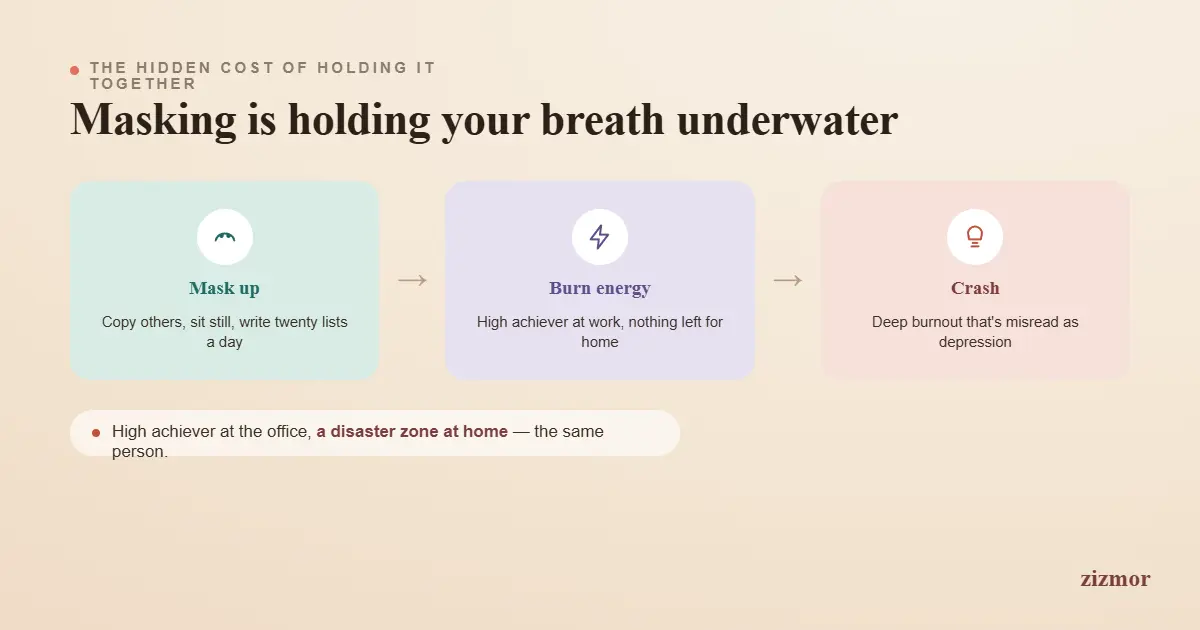
You might write down twenty lists a day. You might check your keys ten times before you leave the house. You might arrive an hour early to every meeting because you are terrified of being late. You copy how other people act so you do not stand out. You force yourself to sit completely still even when your skin is crawling with restless energy.
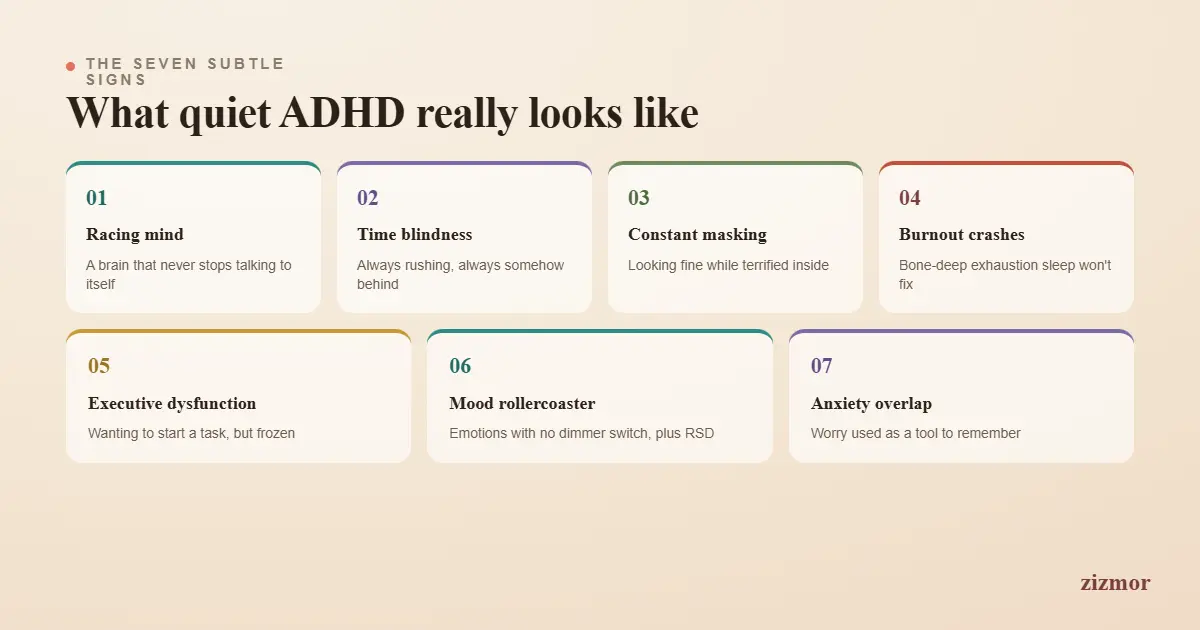
This masking makes you look successful to the world. People think you have everything under control. Inside, you are terrified. You feel like a fake. You worry that if you let your guard down for one second, your entire life will fall apart.
Masking is like holding your breath underwater. You can do it for a little while, but eventually, you have to come up for air. You spend so much energy trying to look normal at work that when you get home, you have nothing left. You collapse on the couch, unable to cook, clean, or speak to your family. This pattern creates a painful split in your life. You are a high achiever at your job, but your home life feels like a complete disaster zone.
This hiding behavior also keeps you from getting help. When you try to explain your struggles to a doctor, they look at your clean clothes, your steady job, and your polite smile. They tell you that you are doing too well to have ADHD. They do not see the massive pile of dirty laundry at home. They do not see the unpaid bills hidden in your drawer. They do not see the sheer amount of tears and panic it took for you to arrive at their office on time.
How Does Constant Masking Lead to Burnout?
You cannot run a car engine at top speed forever without ruining the motor. The same is true for your brain. After years of forcing yourself to look normal, you hit a wall. This crash brings on adhd burnout symptoms in adult women.
This is not standard tiredness that goes away with a good night of sleep. This is a deep, bone-crushing exhaustion. You wake up and feel like you cannot move your arms or legs. The simplest choices feel impossible. Deciding what to eat for dinner makes you want to cry. You might stare at a blank computer screen at work for hours. Your memory gets worse, and you start losing things even more than before. Doctors often look at this crash and think you are just depressed. They do not see the years of heavy masking that caused the crash in the first place.
When burnout hits, your usual coping mechanisms stop working. The calendar that used to keep you on track now sits dusty on your desk. You start making simple mistakes at work that you never made before. You feel a deep sense of dread every time your phone rings or an email pops up. You might pull away from your friends because you do not have the energy to hold a conversation or pretend to be okay.
This state of collapse can last for months or even years if you do not address the root cause. You might try to push through it by drinking more coffee or working longer hours, but this only makes the problem worse. Your body is telling you that it cannot keep pretending anymore. You must learn to work with your brain instead of fighting it.
What Is the Real Impact on Your Daily Tasks?
Think of your brain as a busy airport. The executive functions are like the air traffic controllers. They tell planes when to land, when to take off, and where to park. The executive dysfunction adhd adult women impact is like having no controllers in the tower. The planes are crashing into each other.
You struggle to plan your day. You cannot estimate how long a task will take. You think washing the floor will take five minutes, but it takes an hour. You think writing a report will take all day, so you avoid it for weeks. This dysfunction makes it hard to pay your bills on time, even when you have the money in your bank account. You want to do these things, but your brain refuses to start the engine.
This brain block also affects task activation. When a neurotypical person needs to do a task, like taking out the trash, their brain releases a small spark of dopamine to help them get up and do it. For an ADHD brain, that spark never comes. You can sit on the couch for three hours, staring at a pile of laundry, screaming at yourself in your mind to just stand up and fold it. But you cannot move. This is not laziness. It is real, painful neurological paralysis.
Besides that, paper and digital clutter can quickly take over your life. You open mail and leave it on the counter because deciding where to put it feels too hard. Your email inbox climbs into the thousands. You buy organizing boxes and planners, but they sit empty. Every messy pile in your house becomes a visual reminder of your struggles, feeding into your feelings of shame and failure.
What Do Attention Struggles Look Like at Work?
In a professional office, attention issues look very different from a classroom. The subtle adhd signs professional women show are often hidden behind high energy and creativity. You might be the person who saves the day during an office emergency. You are great under pressure.
When the crisis ends, and you have to do repetitive paperwork, your brain shuts down. You might work late every single night just to keep up with basic emails. You cannot focus during open-concept office hours, so you wait until everyone leaves to start your real work. You might talk over people in meetings because you are afraid you will forget your thought if you do not say it right away. This habit can hurt your work relationships and slow down your career.
Many professional women switch jobs every few years. They love the excitement of a new role, but once the job becomes routine, they lose focus. They feel bored, frustrated, and ready to quit. They worry that they are lazy or that they will never find a career that keeps them happy.
At the same time, you might experience severe task paralysis when you get a large assignment. You do not know how to break it down into small steps, so you do nothing. You wait until the absolute last minute, using the raw panic of a looming deadline to force your brain to focus. While this trick works to get the job done, it leaves you feeling sick, shaky, and completely drained.
Why Are Your Moods on an Endless Rollercoaster?
Many people think ADHD is only about focus. This is a major mistake. The emotional dysregulation adhd adult women experience can be the hardest part of the entire condition. Your brain cannot tone down emotional inputs. When you feel sad, you feel like the world is ending. When you feel happy, you are on top of the world.
You might also deal with a painful issue called Rejection Sensitive Dysphoria. This means your brain reacts to any hint of criticism like a physical blow. If your boss sends a brief email, you might spend three days crying, sure that you are about to be fired. You keep these heavy feelings inside because you do not want people to think you are too dramatic.
This emotional storm can make you feel like you are walking on eggshells inside your own skin. A minor setback, like spilling your morning coffee, can trigger a flood of tears or a burst of hot anger. You might feel incredibly frustrated with yourself for reacting so strongly to small things. You want to stay calm, but your brain's emotional brakes are simply worn down.
This emotional volatility also makes peer relationships difficult. You might avoid social gatherings because you are afraid you will say the wrong thing or misread someone's facial expression. You worry that your friends find you too intense or needy. This fear can cause you to pull back and isolate yourself, which only feeds into your feelings of loneliness.
Are You Treating the Wrong Condition Due to ADHD and Anxiety Overlap in Women?
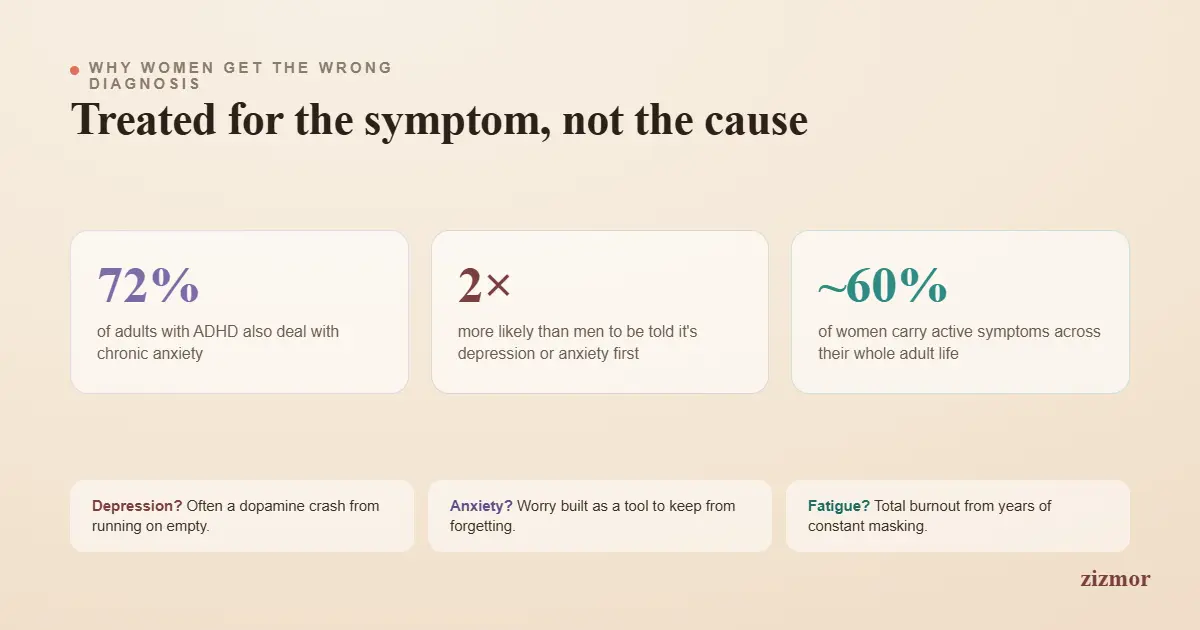
Do you struggle with constant, spinning worry? The adhd and anxiety overlap in women is a massive issue. Studies show that about 72% of adult ADHD patients deal with chronic anxiety.
For many women, anxiety is actually a coping tool they built on purpose. You use your worry to run your life. You tell yourself, "If I do not worry about this meeting every second, I will forget to go". Your anxiety keeps you safe from your ADHD symptoms.
If you go to a doctor and only get treatment for anxiety, you will not solve the real puzzle. The basic mental clutter is still there, generating new worries every single hour. You must treat the focus issue to calm the storm.
Treating only the anxiety with standard talk therapy often leads to frustration. You might learn to identify your anxious thoughts, but you still cannot organize your kitchen, plan your day, or stay focused on your work. This is because your anxiety is not the main problem; it is just a symptom of your brain fighting to survive in a neurotypical world.
Sensory overload is also deeply linked to this anxiety. When your brain cannot filter out background noise, a crowded grocery store or a noisy restaurant can feel like an attack. The bright lights, loud music, and chatter of people overwhelm your nervous system. You might find yourself snapping at your loved ones or feeling a sudden wave of panic. This is not a panic attack in the traditional sense; it is your ADHD brain hitting its limit for processing sensory information.
Why Is ADHD Misdiagnosis in Adult Women So Common?
Because women hide their symptoms so well, doctors frequently miss the truth. This adhd misdiagnosis in adult women leads many to take the wrong path for decades.
When you tell a doctor that you are tired, sad, and cannot focus, they often write down "depression" or "anxiety". A major study showed that females are twice as likely as males to get a depression or anxiety diagnosis in the year before they get their true ADHD diagnosis. You might take different medications for years with zero improvement. You keep feeling like something is wrong with your character, but the real issue is just a simple dopamine shortage in your brain.
This medical bias exists because the diagnostic manuals were written based on boys. Doctors are trained to look for physical hyperactivity, which is rare in adult females. When a woman shows up with emotional storms and fatigue, clinicians naturally lean toward mood disorders instead of looking deeper.
Misdiagnosis can also lead to more serious issues. Women with undiagnosed ADHD are at a higher risk for eating disorders, sleep apnea, substance abuse, and self-harm. They self-medicate with food, alcohol, or shopping to get the quick dopamine hits their brains crave. These coping mechanisms can spiral out of control, causing even more damage to their health and self-esteem.
What Happens to Older Women Facing Menopause?
For many women, the worst of the storm hits after they turn forty. The undiagnosed adhd symptoms adult women over 40 experience often boil over due to hormonal shifts.
When you enter perimenopause, your estrogen levels begin to slide downward. Since estrogen helps make focus chemicals, your brain loses its natural support system. The strategies that kept your life together for forty years suddenly fail.
At this stage of life, you might also have children who get diagnosed with ADHD. As you read about their struggles, a lightbulb goes off. You see your own childhood in their stories. You realize you have been fighting the exact same battle for your entire life.
This realization can feel like a massive shock. You might look back and remember how hard you worked in high school just to get average grades, or how you struggled to keep your college dorm room clean. You understand why you always felt like you were working twice as hard as your peers just to stay in the exact same place.
This midlife discovery can also happen when life demands spike. You might get a big promotion, start a family, or have to care for aging parents. Suddenly, you have too many balls in the air, and your remaining coping tools fail. This drop in functioning is not your fault; it is simply the point where the weight of your daily life becomes too heavy for your brain to manage without real support.
Can You Reclaim Your Life After Late Diagnosis ADHD Symptoms Women Receive?
Getting an answer later in life is a wild ride. The late diagnosis adhd symptoms women carry often bring a powerful wave of different feelings.
First, you feel massive relief. You realize you are not lazy, stupid, or broken. You have a different brain.
Next comes grief. You look back at your school years, your past jobs, and your broken relationships. You wonder how your life would look if you had received help twenty years ago. This grief is natural. But once the dust settles, you can build a life that actually fits your brain.
A late diagnosis allows you to stop fighting yourself. You can start using tools that actually work for your neurobiology instead of trying to follow standard advice that only makes you feel worse. You can rebuild your confidence from the ground up.
Many women find that sharing their diagnosis with other women who have ADHD brings a sense of community. For the first time, they can talk about their messy desks, their lost keys, and their hyper-focus loops without feeling judged. They realize they belong to a large group of bright, creative, and resilient women who are all learning to navigate the world together.
Why Does Your Partner Feel Ignored?
ADHD does not stay inside your head. It spills out into your living room. The adhd relationship challenges adult females face can strain even the strongest bonds.
You might forget to do chores your partner asked you to do. You might lose your temper quickly during simple disagreements. You might space out when they are talking about their day. Your partner might think you do not care about them or that you are lazy.
Adults with untreated ADHD actually face double the divorce rate of other couples. But once you both understand that these actions are signs of a brain difference, you can stop blaming each other. You can work as a team.
You can set up clear, visual chore charts. You can agree to have important conversations only when you are not tired or distracted. You can use calendars that sync with each other so nobody forgets family plans or date nights. This team approach can save marriages and build deep, loving connections.
It is also common for women with ADHD to struggle with sensory overload in the home. A noisy television, clutter on the kitchen table, or children crying can cause immediate irritation. Explaining this sensory limit to your partner helps them understand that your irritability is not an attack on them. You simply need a quiet space to reset your nervous system.
How Do We Actually Build Better Habits?
You do not have to fight your brain every day. We can build smart systems to make life smooth. Successful coping with adhd symptoms adult women use involves taking the pressure off your working memory.
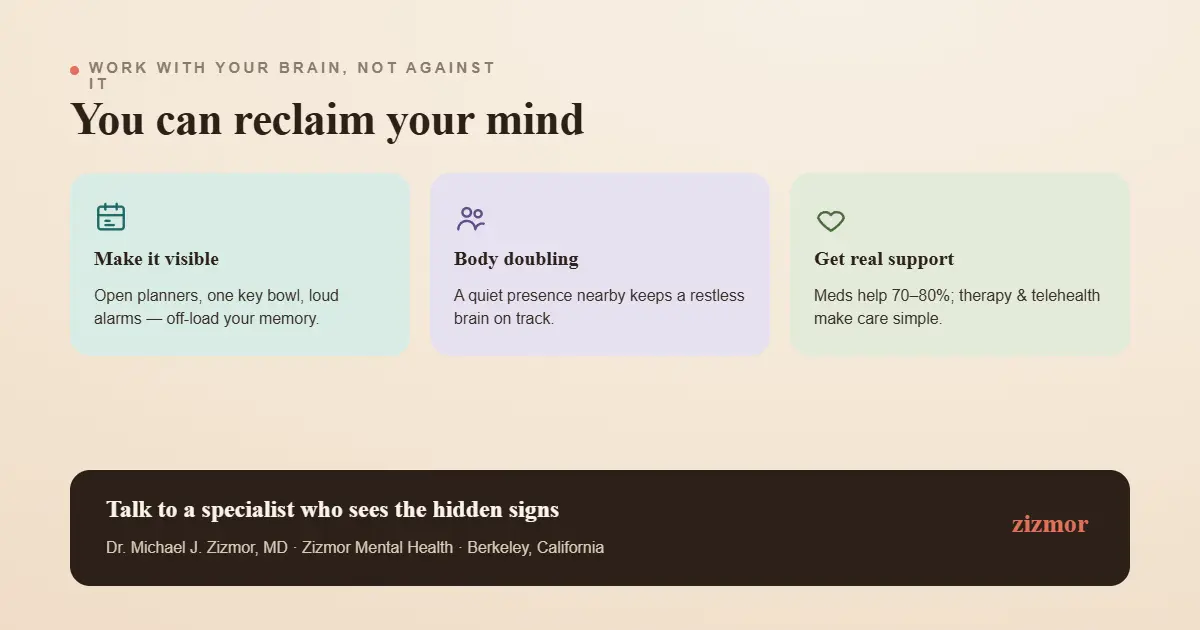
Stop trying to remember everything in your head. Use visual planners that stay open on your counter. Put your keys in the exact same bowl by the door every single day. Set loud phone alarms to tell you when to leave the house, not just when the meeting starts.
You can also try a method called "body doubling". This means having someone sit near you while you do hard chores or boring work. Their quiet presence helps keep your brain on track.
Medical tools are also incredibly helpful. Focus medications work for 70% to 80% of people with ADHD. They help balance your brain chemicals so you can choose where to put your attention. Therapy, like Cognitive Behavioral Therapy, helps you change negative self-talk and build better organizational systems.
Many women now use telehealth to get help. About 46% of adults with ADHD have used virtual visits to connect with their healthcare team. This makes it simple to talk to a specialist, get a proper diagnosis, and manage your treatment from the comfort of your own home.
In addition, learning to say no is a vital skill. Many women with ADHD overcommit because they want to please others or overestimate their free time. They end up with schedules that are packed to the brim, leading straight to burnout. Guarding your calendar like a treasure map is a necessary step to protect your mental health.
Moving Forward with Confidence
Seeing these subtle adhd symptoms adult women live with is your first step to a better life. You do not have to live in a state of constant mental exhaustion or feel like you are failing. Your brain is unique, and with the right tools, you can thrive in your career, your relationships, and your daily life. Talk to a specialist today to start your journey.
FAQs
Can adult women inherit ADHD from parents?
Yes. Research shows a strong genetic link, meaning you likely inherited this brain trait from your mother or father. Stop blaming your character flaws today. Schedule a formal diagnostic test right now to break this lifelong generational cycle.
Can blood tests diagnose adult female ADHD?
No. Doctors cannot use simple blood draws or brain scans to confirm your condition. Clinicians must evaluate your detailed life history and symptoms. Stop waiting for a magical lab result. Call a qualified medical specialist today for help.
Does untreated adult ADHD increase car accidents?
Yes. Studies show that unmanaged attention issues significantly increase your risk of motor vehicle crashes due to sudden distractions. Do not gamble with your physical safety on the road. Contact a doctor today to reclaim complete focus.
Do primary care doctors treat adult ADHD?
Yes. Primary care physicians frequently evaluate patients and prescribe effective treatments for adults living with this hidden disorder. Stop putting off your care because of long specialist waitlists. Book an immediate appointment with your local physician today.
Do adults completely outgrow their ADHD symptoms?
No. Research proves that about sixty percent of women continue struggling with active symptoms throughout their entire adult lives. Stop waiting for your brain blocks to magically disappear on their own. Get expert medical evaluation and support today
This article is for general information only. It is not a substitute for individual medical advice. For guidance specific to your situation, please contact our team or start an intake to speak with a clinician.